News Markets & Companies
Akzo Nobel and Axalta merge: Experts anticipate shift in global balance of power
How do industry insiders assess the planned merger between Akzo Nobel and Axalta?
Ben Scharff, Managing Director at Grace Matthews, and Markus Loy, Partner at Loy & Co Corporate Finance, share their perspectives on the strategic rationale, risks and broader implications of the allstock deal. The transaction is expected to create a coatings group generating about USD 17 billion in annual revenue, marking a significant step in the sector’s ongoing consolidation.

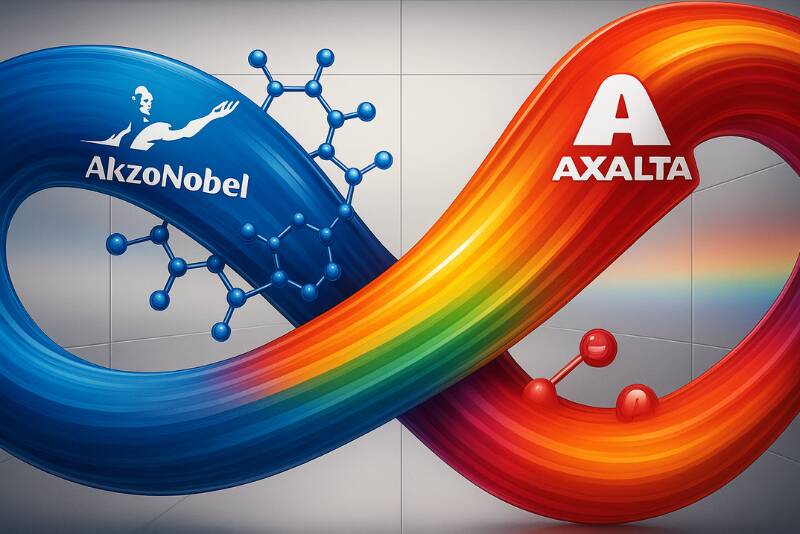
The planned allstock merger between Akzo Nobel and Axalta Coating Systems is set to reshape the global coatings industry. Under the agreement, Akzo Nobel shareholders will own 55 % of the new company and Axalta shareholders 45 %. The combined group is projected to generate roughly USD 17 billion in annual revenue and achieve about EUR 600 million in cost synergies.
According to Ben Scharff, Managing Director at Grace Matthews, “The Akzo Nobel–Axalta combination is very much in line with the longrunning consolidation trajectory across coatings and specialty chemicals. Scale is increasingly critical – not just for procurement advantage but to manage regulatory complexity, absorb rawmaterial volatility and fund the R&D customers expect in sustainability and product performance.”
He emphasises that Akzo Nobel and Axalta bring complementary strengths: “Akzo Nobel leads in marine, protective and selected industrial lines, while Axalta is strong in refinish and transportation coatings. The combined portfolio offers better geographical and technological balance.”
From a European advisory perspective, Markus Loy, partner at Loy & Co Corporate Finance, sees solid strategic logic in the transaction:
“Akzo’s automotive business so far amounts to roughly EUR 1.4 billion, mainly in the European OEM segment. With Axalta there is an additional EUR 3.5 billion in automotive revenue – EUR 2.5 billion of which comes from the Americas and Asia. Axalta’s refinish business is regarded as particularly strong in growth and margins.”
He adds, “Axalta also contributes around EUR 1.3 billion in industrial coatings to Akzo’s EUR 2 billion in this area, with relatively little overlap between the two.”
Growing pressure on competitors
“The merger effectively transforms Axalta from a focused specialist into a broadly diversified global coatings player,” says Scharff. “It also compresses the upper tier of the market and raises expectations for service, innovation and customer coverage.”
Loy expects the new group to be one of four global leaders: “We will then have a top bracket of Sherwin Williams, PPG, Akzo/Axalta and Nippon Paint.” For midsized businesses, that will intensify the need to either grow or sharpen their niche positioning.
Integration challenges ahead
Integrating operations and cultures will be decisive for longterm success. “Bringing together two corporate cultures – the Europeancentred Akzo Group and the Americanrooted Axalta – will be anything but easy,” says Loy. “Especially in Europe, where overlaps are strong, the process will tie up resources for years.”
Scharff warns of the commercial dimension: “Customer continuity is the first area to watch. Relationships in refinish and industrial coatings are built over many years through technical service, so any perceived instability could lead to customer churn.”
Moody’s downgrade underscores financial strain
In the wake of the announcement, Moody’s downgraded Akzo Nobel’s long‑term rating from Baa2 to Baa3, while revising the outlook from negative to stable.
The agency cited the high initial leverage expected after completion of the merger. A planned dividend payout of EUR 2.5 billion is to be largely debt‑financed, leading to a pro forma gross‑debt‑to‑EBITDA ratio of 4.6x for 2025.
The stable outlook reflects Moody’s expectation that the combined company will commit to reducing leverage to around 2.0x – 2.5x once integration benefits and EUR 600 million of targeted cost synergies materialise.
Moody’s decision highlights investor awareness of the integration’s complexity. As part of its preparations, Akzo Nobel cancelled a planned EUR 400 million share buy‑back, preserving flexibility to support the transaction.
Further consolidation expected
Scharff expects the deal to trigger reactions across the sector: “A transaction of this size always prompts competitors to reassess their scale, cost position and technology roadmap.”
Loy anticipates that acquisitions of smaller specialists and adjacent businesses – such as construction chemicals or sealants – will remain likely.
He concludes: “The coatings industry is characterised by economies of scale more clearly than most others. Midmarket players face a strategic choice: gain scale through mergers and acquisitions, or focus sharply on defensible niche leadership through innovation.”
Here you can read the full interviews with Markus Loy and Ben Scharff.