News Markets & Companies
Smart coatings: from lab curiosity to industrial reality
A European Coatings survey reveals that antimicrobial, anti-corrosion and self-cleaning technologies are driving the smart coatings market – but significant barriers remain.

An anonymous survey conducted by European Coatings among more than 30 industry professionals, combined with in-depth interviews with three experts, paints a nuanced picture of a market segment brimming with technological promise but still grappling with significant barriers to scale.
Beyond awareness – but not yet mainstream
Only 10% of respondents said smart coatings play no role in their everyday business. The majority – 59% – described their involvement as marginal, while almost a third (31%) reported that smart coatings already form a significant part of their activities.
Nadine Rehfeld, Group Manager Functional Coatings for Exterior Application at the Fraunhofer Institute for Manufacturing Technology and Advanced Materials IFAM, confirms: “Due to the high expected benefits of smart coatings and ongoing developments in the raw materials and coatings market, their significance continues to grow.”
Antimicrobial coatings lead, construction drives demand
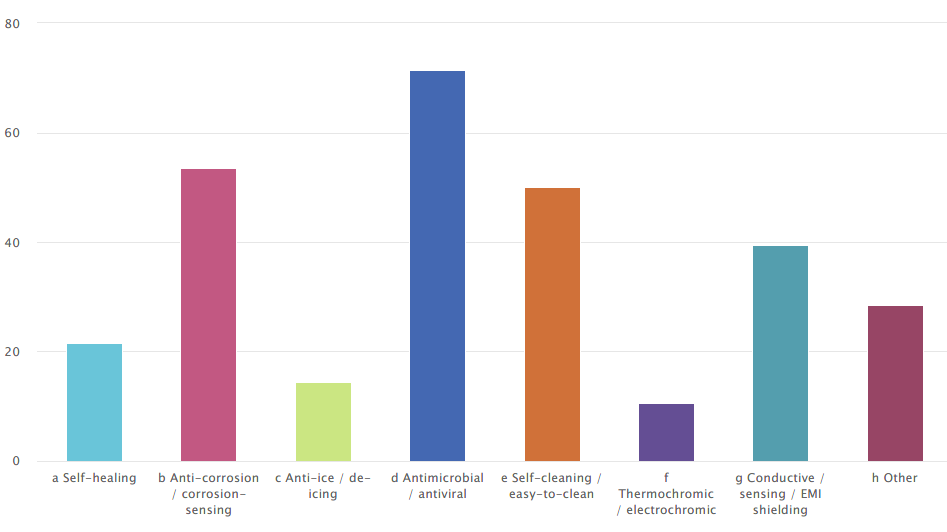
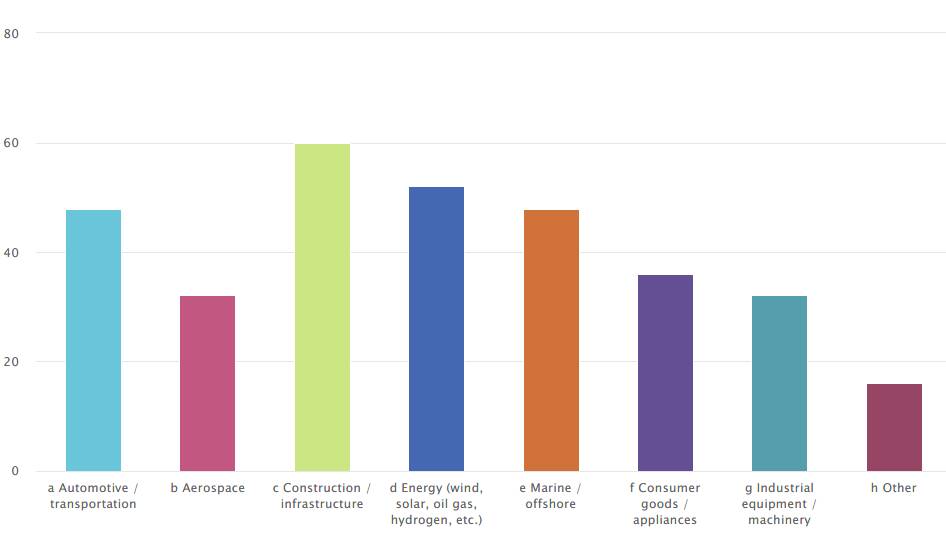
Antimicrobial and antiviral coatings top the relevance ranking at 71%, followed by anti-corrosion coatings at 54% and self-cleaning technologies at 50%. Construction and infrastructure emerged as the strongest demand sector in Europe (60%), followed by energy (52%).
Cost and conservative customers slow adoption
High cost is cited by 67% as the main barrier, followed by a conservative customer base (58%) and lack of end-user awareness (54%). Eugene B. Caldona, Assistant Professor at North Dakota State University, identifies cost as fundamental: “The main drawbacks are the precursors used in their preparation, which can be quite expensive, and their lifespan as being ‘smart’.”
Dr James W. Rawlins, Professor of Polymer Science and Engineering at The University of Southern Mississippi, argues the core challenge lies beyond the mechanism itself: “The biggest drawbacks are usually not the ‘smart mechanism’ itself, it’s everything around it: 1) Durability/depletion, 2) Real-world survivability, 3) Quantification, qualification and measured comparability, and 4) Regulatory and sustainability constraints (especially in Europe).”
Cautiously optimistic outlook
The full market report in the March issue of European Coatings Journal explores the most promising breakthroughs ahead, how regulation is reshaping R&D, and what it will take for smart coatings to cross the threshold from niche innovation to industrial standard.
Read the complete report in the March 2026 issue of the European Coatings Journal.
Event tip
In a 5‑hour European Coatings Webinar “Smart Coatings” on 27 May you will gain a clear, practice‑oriented overview of what makes a coating “smart” and how such systems are designed. Marco Heuer of Evonik will outline the basic principles of stimuli‑responsive behaviour and the main functional classes of smart coatings, discuss how smart functionalities can be integrated into real coating formulations and processes, and how they interact with classic requirements like adhesion, hardness, flexibility, appearance and VOC limits. Typical testing and evaluation approaches will also be introduced.