News Coatings Technologies
Biomimetic UV-curable coating combines anti-icing and transparency
Researchers have developed a UV-curable biomimetic coating that mimics the surface of rose petals, combining excellent anti-icing performance with high optical transparency and environmental durability. The system shows strong potential for applications in aircraft windshields, UAV sensor windows and solar panels.
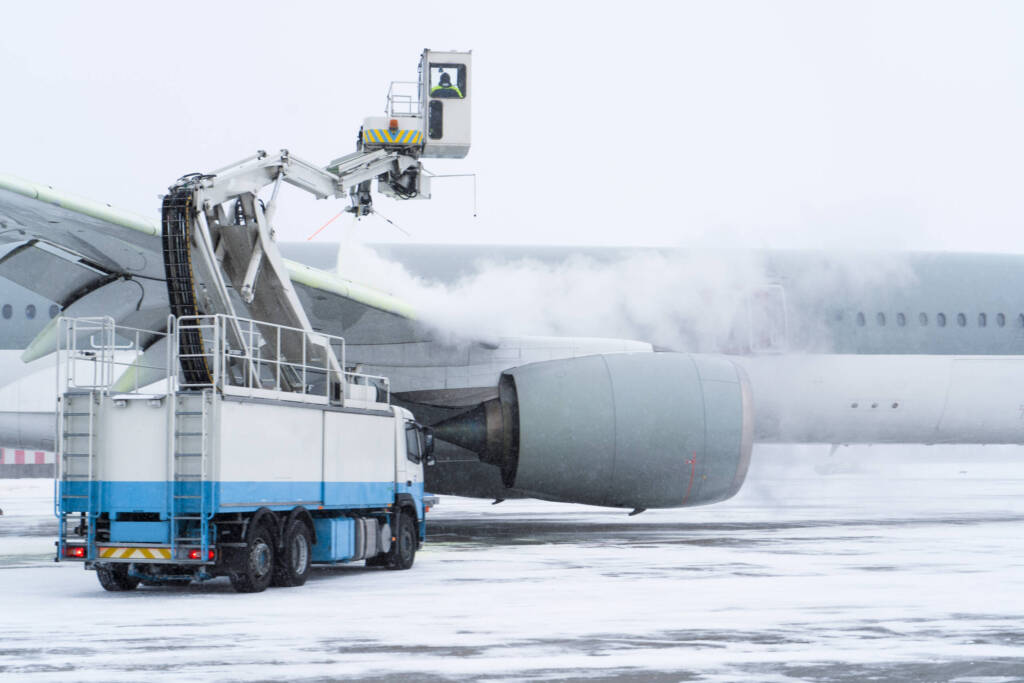
Anti-icing coatings typically face an inherent trade-off between functional performance, optical transparency and long-term environmental durability. To address these challenges simultaneously, researchers have developed a multifunctional biomimetic coating designed to integrate efficient passive anti-icing behaviour with high optical transmittance and robust durability.
The system is based on a newly synthesised UV-curable fluorinated polysiloxane/polyurea (FPSU) resin serving as the polymer matrix. Al₂O₃ microspheres were incorporated onto the surface via a spray-coating approach. Simultaneous resin crosslinking and robust anchoring of the microstructures were achieved through in situ UV curing, resulting in the FPSUA coating, which mimics the hierarchical surface morphology of rose petals.
Reading tip: Functional Coatings
The EC Tech Report “”Functional Coatings“” gives you an up-to-date bundle on functional coatings with articles, videos and other handpicked content. In addition to technical articles about the latest technical developments, this all-in-one multi-media pack is rounded off with valuable market insights and important fundamentals about functional coatings formulation.
Strong anti-icing performance across substrates
The FPSUA coating achieves a static water contact angle of 158.22° and a sliding angle of 5.45°. On glass substrates, the freezing time increased from 25 s in the uncoated state to 618 s after FPSUA application, while ice adhesion strength dropped sharply from 357.96 kPa to 18.94 kPa. Applied to four different substrates, the coating consistently showed freezing times between 456 and 618 s, ice adhesion strengths between 18.94 and 31.86 kPa, and stable performance after 20 freeze-thaw cycles.
Durability and optical transparency confirmed
The matrix itself displays a surface energy of 21.19 mN/m, tensile strength of 2.28 MPa, elongation at break of 468.61 % and transmittance of 94.07 % at 589 nm. After rigorous exposure to sand impact, sandpaper abrasion, alcoholysis and freeze-thaw cycles, the static contact angle remained above 150° and the sliding angle below 11.49°. The final FPSUA coating exhibits a refractive index of 1.432 and a transmittance of 80.32 % at 589 nm. These combined properties highlight strong potential for anti-icing and de-icing applications in critical transparent components such as aircraft windshields, UAV sensor windows and solar panels.
Source: Liu, J. et al., UV-curable biomimetic fluorinated polysiloxane/polyurea–Al₂O₃ coating with outstanding anti-icing performance, durability, and optical transparency. Progress in Organic Coatings, 110129 (2026).