News Application Areas
Aerospace coatings: “Every layer, every micron of film build and every application step must be considered carefully”
Combining performance, durability and sustainability in aerospace coatings is no easy task. Aurore Bournazel, Segment Manager at Akzo Nobel, discusses how advances in formulation and application processes are addressing weight reduction, efficiency and environmental challenges in one of the most demanding industries.
Which technical trade-offs are currently most challenging, and which strategies appear most promising?

Aurore Bournazel: From an aerospace perspective, the issue is less about accepting trade-offs and more about giving customers confidence that several demanding requirements can be achieved at the same time. Airlines and Maintenance, Repair, and Overhaul (MRO) providers need coating systems that are lighter, faster to apply, and deliver consistent appearance and long-term durability, while still meeting strict aerospace performance requirements. Every layer, every micron of film build and every application step must be considered carefully, because the system needs to withstand UV exposure, weathering, hydraulic fluids, cleaning agents, erosion and repeated maintenance cycles.
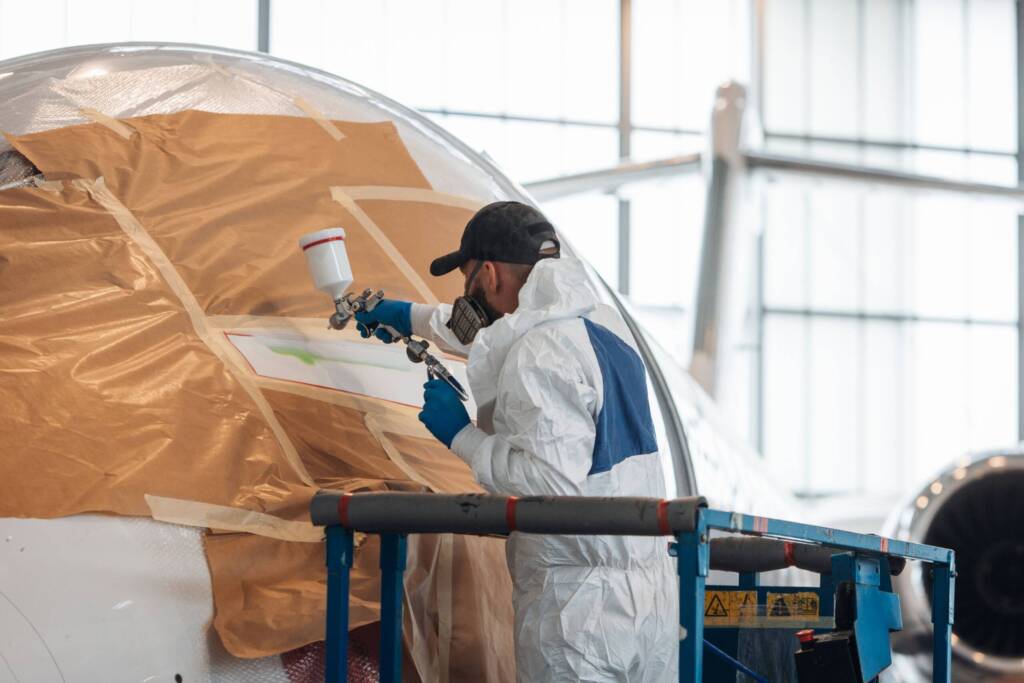
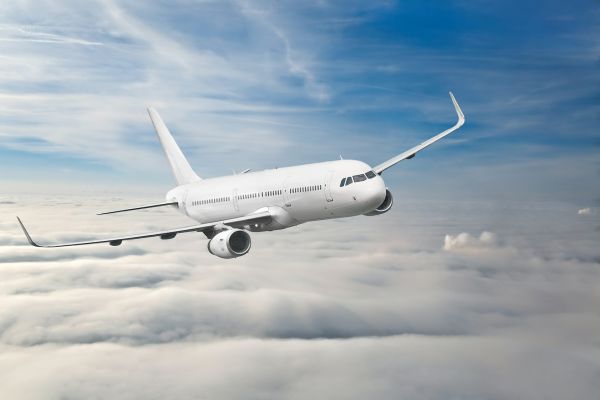
The technical opportunity is not to choose between weight, speed and performance, but to prove that the coating system can deliver all three reliably in real-world environments. An example is Akzo Nobel’s Aerobase UPD technology, which has improved film build control and sag resistance, and when combined with a cross-coat application technique, it delivers the required hiding power and finish quality with a single basecoat layer. In recent trials on Airbus A 320 aircraft, it delivered a coating weight saving of 24 kg per aircraft, demonstrating how formulation and application efficiency can translate into a measurable benefit.
The same weight-saving mindset is also being applied to special effect finishes (mica and metallic colours), which are demanding but deliver the distinctive liveries that airlines want. By optimising our colour formulations for Aerobase special effects, we have developed a direct-to-primer capability for selected colours, removing the need for a base colour layer. This approach reduces the total coating system build-up for Aerobase special effects, and if we compare a high-coverage Aerobase special effects basecoat/clearcoat system on a wide body aircraft like an A 380 with a direct-to-primer solution our testing indicates that the weight saving would be in the region of 300 kg.
Where are the biggest challenges – and the greatest advances – in combining sustainability with performance?
Bournazel: The challenge is not simply in the development of new coating technologies that can help OEMs and airlines reduce environmental impact, it is also in the time that it takes to qualify them for use in one of the most technically demanding and tightly controlled industries.
Any new coating system has to meet strict requirements for safety, compliance, corrosion, chemical resistance, weatherability, adhesion and service life before it can be adopted. These requirements are essential as aircraft coatings are part of a wider protection system, helping to protect aircraft structures and the long-term operational reliability. We are committed to ongoing R&D, but since the qualification and approval for new coating solutions can extend over several years, the reality is that customers must take advantage of incremental improvements within existing, approved coatings.
Our technical teams work with airlines to help them rethink how liveries can be delivered using proven coating technology. The goal is to support lighter, more efficient aircraft finishes that contribute to reducing aircraft weight, fuel consumption and the associated emissions. These improvements are coming from optimised colour formulation and lower system build-up. We also help our customers to tailor and optimise the coatings replacement and maintenance plan for individual aircraft throughout their fleet.
Airlines recoat their aircraft every 10 years, but our Aerofleet Coatings Management is a digital, data driven service which uses drones to conduct a high-resolution visual inspection and advanced coatings assessment to measure the performance of the coating including the dry film thickness, gloss and colour retention. This is combined with flight and environmental data to allow more accurate maintenance decisions. All data is captured in a structured digital audit and fed into a central database, where it is analysed over time to model coating performance and predict optimal maintenance windows.
This interview is part of the Expert Voice section in the European Coatings Journal.Read the complete piece in the July/August issue.