News Coatings Technologies
Mechanical deformation drives water uptake in coil-coatings
A new study investigates how mechanical deformation influences water uptake and failure mechanisms in polyester/melamine coil-coatings on hot-dip galvanized steel. Using Erichsen cupping tests combined with electrochemical impedance spectroscopy, the researchers identified a critical deformation threshold above which blistering and coating failure are strongly accelerated.
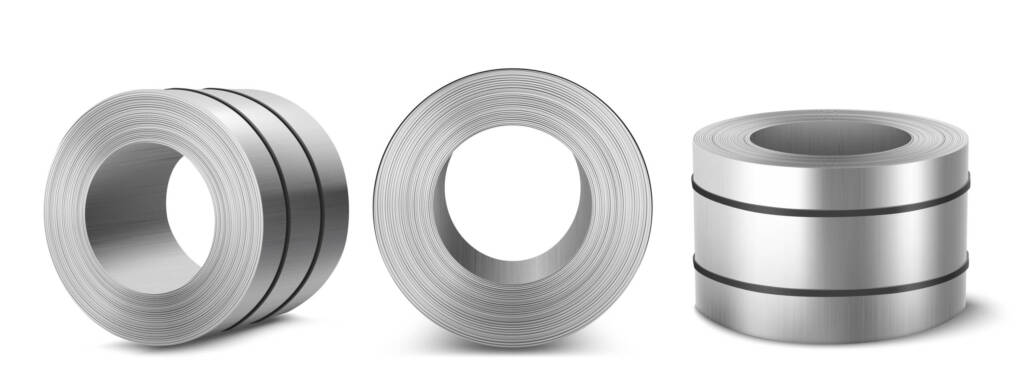
Coil-coated steel is widely used in the construction and appliance industries, where formability and adhesion of the applied coating system are critical for long-term performance. The Erichsen cupping test is a standard method for evaluating these properties, as it generates mechanical strains comparable to those encountered in industrial forming processes. In this study, researchers examined a hot-dip galvanized steel substrate coated with a polyester/melamine primer and topcoat, applying mechanical deformations at penetration depths ranging from 1 mm to 6 mm using a spherical indenter.
Coating thickness along the deformation profile was measured on cross-sections by optical microscopy, revealing non-uniform thinning that was most pronounced at the dome apex and in the intermediate zone. The effective contact area between the coating and the electrolyte in the electrochemical cell was determined by 3D scanning, providing a more accurate basis for subsequent calculations.
Reading tip: Coil Coating
Delve into the specialized field of coil coating with “”Coil Coating.”” Learn about coil coating processes, substrate preparation, primer and topcoat formulations, curing methods, and quality control measures. Gain insights into optimizing coil coatings for performance and durability.
Electrochemical analysis and deformation threshold
Electrochemical impedance spectroscopy (EIS) was performed in a 0.5 M NaCl solution over 72 h to assess water uptake and anticorrosion performance. The influence of coating thickness and effective contact area on EIS-calculated water uptake was examined in detail. While the calculated water uptake remained within experimental uncertainty and did not vary significantly with mechanical deformation, dielectric analysis suggested faster molecular mobility with increasing deformation, implying enhanced water uptake at the molecular level.
A critical deformation threshold was identified at penetration depths of 5 mm and above, beyond which blister initiation was strongly accelerated. Post-mortem characterisation using scanning electron microscopy with energy-dispersive spectroscopy (SEM-EDS) and quantitative computed tomography (QCT) confirmed failure mechanisms including cracks in the zinc layer and loss of coating adhesion leading to blistering. The combined approach provides relevant dielectric and electrochemical markers for understanding how mechanical deformation influences water uptake and coating failure, offering valuable insight for the development and quality control of coil-coating systems.
Source: Jero, D. et al., Influence of the mechanical deformation on the water uptake and failure mechanisms of polyester coil-coatings. Progress in Organic Coatings, 110176 (2026).