News Markets & Companies
Market report: From cool roofs to EV batteries
From a hydrophobic paper coating that transforms waste paper and cellulose into waterproof self-cleaning surfaces using silicone-laden nano silica to an intumescent hybrid coating, based on amino acids modified with tannic acid and phytic acid, that on exposure to heat, forms a dense ceramic char that protects wood surfaces from fire damage, functional coatings are continuing to push boundaries to meet the ever-increasing demand for efficiency, durability and sustainability. A round-up of factors and figures from the world of functional coatings. By Chris Malthouse.

From a hydrophobic paper coating that transforms waste paper and cellulose into waterproof self-cleaning surfaces using silicone-laden nano silica to an intumescent hybrid coating, based on amino acids modified with tannic acid and phytic acid, that on exposure to heat, forms a dense ceramic char that protects wood surfaces from fire damage, functional coatings are continuing to push boundaries to meet the ever-increasing demand for efficiency, durability and sustainability.
MARKET SIZE AND GROWTH POTENTIAL
Estimating the market size and value of the global functional coatings market appears not to be an exact science due to the very nature of the product and how it is defined. For example, according to Precedence Research the market was estimated to be worth USD 544.43 billion (EUR 464.52 billion) in 2024 and is expected to grow to USD 573.28 billion (EUR 489.14 billion) in 2025 and to reach around USD 912.47 billion (EUR 778.54 billion) by 2034, expanding at a CAGR of 5.3% between 2024 and 2034. While North America is presently the largest market, Precedence expects the Asia Pacific region to expand at the fastest CAGR over the same period.
Meanwhile, Lucintel expects the market to reach an estimated USD 753.2 million (EUR 642.59 million) by 2030 with a CAGR of 5.4% from 2024 to 2030. It agrees that the Asia Pacific Region will remain the fastest growing region due to swiftly growing economies such as China and India, escalating investments in infrastructure development, and increasing demand from key sectors, such as automotive, construction, and electronics in this region.
MARKET DRIVERS AND TRENDS
The functional coatings market is continuing to be driven by a combination of technological innovation and rising demand from various end-use industries, such as aerospace, automotive, construction, marine, renewable energy and electronics, looking for energy-efficient and environmentally friendly technologies. One of the primary drivers is the increasing demand for enhanced surface properties such as corrosion resistance, abrasion resistance, and thermal stability.
Looking at the electronics market, functional coatings are used in a variety of electronic devices, including smartphones, laptops, tablets, and televisions. These coatings provide protection from corrosion, wear, and abrasion. They can also improve the performance by increasing conductivity, reducing electromagnetic interference, and enhancing thermal management. According to marketresearchfuture.
According to marketresearchfuture.com, the electronics market is expected to grow from USD 2.6 trillion in 2023 to USD 4.5 trillion by 2030 at a CAGR of 7.9%. The Asia Pacific region is expected to be the largest market for electronic devices, accounting for more than 50% of the market by 2030. Digital transformation is also a key factor with artificial intelligence and advanced simulation being used to design and test coating properties virtually, therefore reducing development time and costs, and increasing efficiency and customisation. Environmental regulations are continuing to push industries to adopt eco-friendly solutions, leading to increased demand for water-based and low-VOC coatings, especially in North America and Europe.
I caught up with Dr Victoria Scarborough, Vice President of Collaborative Innovation for the ChemQuest Group and asked her about current trends and challenges with respect to the functional coatings market. One of the most important megatrends she feels is climate change. “Overall climate change is going to take hold because it’s not going anywhere. We are getting torrential rains in the United States in lots of places and lots of flooding. So, there’s damage that’s going to be caused by all of that. And that has to be repaired. And you have to have a lot more functional coatings that add mould and mildew resistance, water resistance and UV resistance.” She went on to add that in parts of the world where it is getting hotter, a lot more durability will be required from coatings.
Another driver, she said was the growth in electric vehicles (EVs). EV batteries depend on coatings to maintain optimal temperatures, reduce the risk of fire damage, and mitigate electrical interference. One of the most important sectors of functional coatings in Scarborough’s view, is cool roof coatings. “Cool roof coatings is a hot topic. it’s helping reduce the cost of cooling the buildings, reducing the impact on the electrical grid for the demand for air conditioning. So, it’s very important. It could be literally, for some areas, a lifesaver for the grid itself. Not having brownouts based on the fact that everybody’s trying to cool the building.”
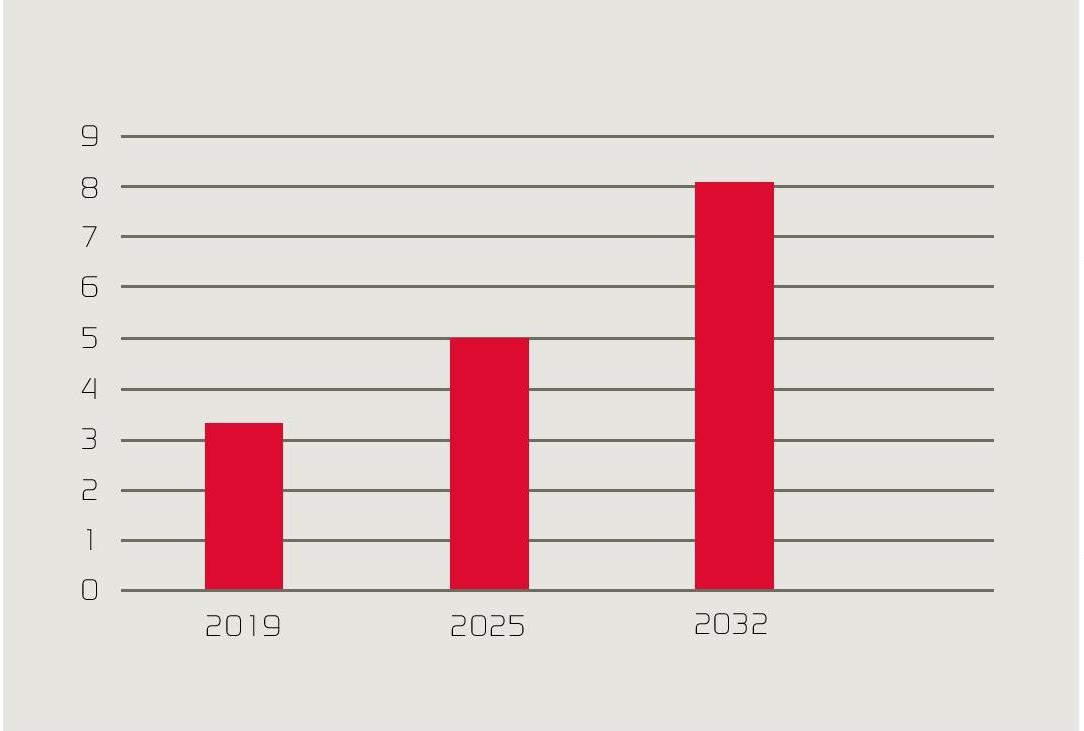
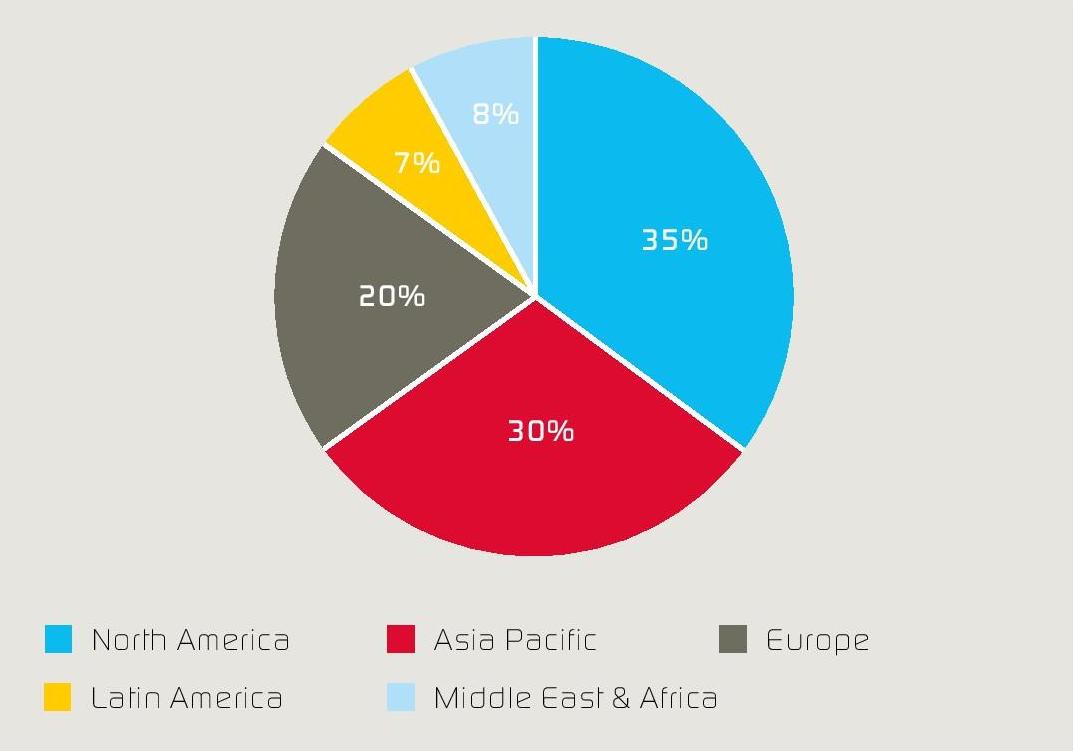
According to the latest report from persistencemarketresearch.com, the global cool roof market’s size is expected to rise from USD 5 billion (EUR 4.27 billion) in 2025 to USD 8.1 billion (EUR 6.9 billion) by 2032 at a CAGR of 7.2%. By product the largest share in the market in 2025 is projected to be acrylic coatings at 36.1%, and by technology, water-based at 40%. In 2023, North America accounted for the largest share of the cool roof coatings market revenue, contributing approximately 35%, closely followed by Asia Pacific with 30%. The U.S. Green Building Council’s LEED certification programme promotes the use of cool roofing as a strategy to earn points towards sustainability certification, while the U.S. Department of Energy advocates cool roof coatings as lowcost retrofit alternatives for existing buildings, with approximately 1.86 billion square metre of commercial roofing space accessible for retrofitting and on the west coast, California’s Title 24 building energy efficiency standards mandate cool roofing systems on both new residential and non-residential buildings.
However, a major challenge in this sector is the initial cost associated with the application of cool roof coatings, which can deter some building owners from making the investment. Another answer to keeping buildings cool was launched in China in May this year. This new thermal insulation coating system can cool down buildings and make them more energy efficient. Featuring a radiative cooling topcoat and a thermal radiation barrier mid-coat, the coating acts like a sunscreen and means the surface temperature of buildings can be lowered by up to 10% during hot summer months, compared with using conventional coatings. Looking to trends in the future, Scarborough added that we should be keeping an eye on the 3D construction market and the increasing use of wraps on planes.
CURRENT CHALLENGES
As with all markets, fluctuating raw material prices and supply chain disruptions are ongoing, and the situation is not helped by shifting tariffs, escalating trade wars and an increasingly highly volatile geopolitical climate. As Scarborough succinctly put it: “We have some boomerangs from our current administration that might affect the supply chain and the tariff situation, and that creates chaos in the market, particularly with so many raw materials coming in. That creates some issues with the supply chain and that’s going to raise costs. And we cannot simply fill the gap!”
Another challenge is regulatory compliance, dealing and keeping up-to-date with complex regulations on subjects such as VOC emissions, hazardous substances, and waste management, across different regions can be time-consuming and costly. Scarborough also mentioned her concerns over the use of biocides and of PFAS (Per- and polyfluoroalkyl substances), which are used in a lot of products in the paint and coatings industry, and PFAS substitutes, which are being actively marketed even though they don’t always meet the demand or the need. “If you can get effective and safe at the same time, that’s always going to be an issue, if you have to kill something like mould, mildew, bacteria etc, then you have to balance that with how safe it is to use around everybody.”