News Coatings Technologies
Virucidal PU hybrid coating: Long-term protection against coronaviruses thanks to calcium hydroxide
A Canadian research team has developed a novel polyurethane-calcium hydroxide coating that exhibits high antiviral efficacy against human coronaviruses – with proven long-term effectiveness lasting over a year.
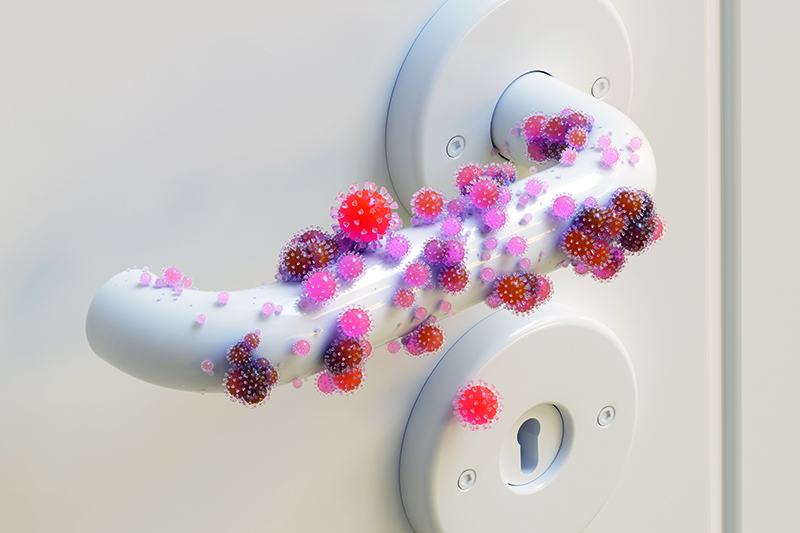
A new hybrid coating made of polyurethane (PU) and calcium hydroxide (Ca(OH)₂) is proving to be a promising candidate for antiviral surfaces in public and industrial areas. Researchers at McGill University and UQAM report sustained efficacy against two tested human coronaviruses (hCoV-OC43-RLuc and hCoV-229E-RLuc). The coating achieved a reduction in viral load of up to four log levels – over a period of more than twelve months.
The effectiveness is based on the controlled release of Ca²⁺ ions, which have a virucidal effect over a longer period of time. The modification of the Ca(OH)₂ particles with polysorbate 80 (Tween 80) plays a decisive role in this, improving their dispersion in the PU matrix and preventing unwanted side reactions. The result is a more even distribution of the active ingredients with a stable effect on the coating surface.
Reading tip: Functional Coatings
The EC Tech Report “Functional Coatings” gives you an up-to-date bundle on functional coatings with articles, videos and other handpicked content. In addition to technical articles about the latest technical developments, this all-in-one multi-media pack is rounded off with valuable market insights and important fundamentals about functional coatings formulation.
Safe and long-lasting solution for contact surfaces
In addition to its antiviral effect, the coating also meets biocompatibility requirements. In vitro tests showed no cytotoxic effects, making it suitable for use on frequently touched surfaces such as door handles, tables or handrails in public areas. The researchers emphasise the relevance of such passive protection solutions, especially in times of increasing threats from novel pathogens and growing demands on hygiene standards.
The development offers a long-lasting alternative to volatile disinfectants and could contribute as a permanent protective measure to reduce virus transmission via surfaces.
Source: Progress in Organic Coatings, Volume 200, March 2025, https://doi.org/10.1016/j.porgcoat.2024.109006