News Coatings Technologies People & Careers
The digital coatings lab: A university perspective
Commercial digital R&D platforms are becoming increasingly capable. Universities operate under different financial, scientific and organisational constraints. Experience at the Technical University of Denmark shows why, in some cases, control and extensibility can matter as much as the feature list.
Why not simply buy a commercial platform?
Digitalisation has become a central topic in coatings R&D. The promises are familiar: shorter development cycles, better use of historical data, more efficient experimental design, improved traceability and, increasingly, AI-assisted formulation and decision-making. Commercial platforms now combine functions that once required separate electronic laboratory notebooks, formulation tools, databases and analysis software. Many are highly polished and much more capable in generic R&D functions than anything a small university team could realistically develop on its own.
That raises an obvious question: why would a university research centre spend years building yet another digital platform? At CoaST, the coatings research centre at the Department of Chemical and Biochemical Engineering, Technical University of Denmark (DTU), this is a question we have both asked ourselves and heard repeatedly from others. Universities can benefit from many of the same digital capabilities as industry, but academic R&D operates with a different set of goals and constraints.
A coatings company can justify digital infrastructure expenses through value creation: productivity gains, faster development, reduced experimental cost or faster time to market. Universities also care about efficiency, but they primarily produce knowledge and train the next generation of scientists and engineers. Research groups depend heavily on time-limited national, European and industrial projects, and long-term recurring software subscriptions may not fit naturally into project budgets. A platform may be affordable during a well-funded period and much harder to sustain several years later. Long-term dependence on proprietary software also introduces some uncertainty if a service is discontinued or a provider changes its business model. If workflows, data structures and institutional knowledge become tightly coupled to one platform, losing access can become a research-continuity problem.
For us, long-term control over the research environment therefore became an important requirement. Subscription-based platforms provide immediate access to mature and sophisticated tools, while excellent free and open-source electronic laboratory notebooks (ELNs), laboratory information management systems (LIMS) and specialised workflow packages can cover many academic needs. Our requirements went further because developing and testing new digital methods is itself part of our research, and the platform must accommodate highly specific hardware, analysis pipelines and workflows.
When the method is part of the result
A second difference is scientific transparency. In industrial R&D, the primary question may be whether a model helps identify a better formulation, while it might be secondary how the model actually works. In academia, however, optimisation is often not the main objective at all. Experiments are frequently designed to generate new knowledge or improve the fundamental understanding of a material or mechanism rather than to improve a product. In such cases, the model itself can become part of the scientific contribution. If Bayesian optimisation proposes the next experiment, researchers may need to report the surrogate model, acquisition strategy, and treatment of constraints and noise. If a neural network analyses coating defects, its model architecture, loss function, optimiser, training procedure and validation strategy have to be understood well enough to support a publication. For a random forest, the relevant features, number and
depth of trees, feature sampling, hyperparameter optimisation and separation of training, validation and test data may matter as much as the final prediction.
Commercial software is routinely used in academic research, including proprietary tools. The difficulty arises when a scientific conclusion depends materially on a method that cannot be described or interrogated at the level required for reproducibility. Academic research therefore needs enough methodological control to understand how a result was generated and to adapt or replace the method as the research question evolves.
At CoaST, this requirement is particularly important because digital methods are research topics in their own right. PhD projects have developed, among other examples, random-forest-based segmentation of intumescent char cross-sections followed by porosity and pore-shape analysis, and convolutional-neural-network-based detection of biofouling on coatings exposed at the CoaST Maritime Test Centre in Hundested, Denmark. These methods are research outputs in their own right that should be integrated into the digital platform once tested, improved, published and, where appropriate, made open source.
Connecting the digital and physical laboratory
Coatings research does not stop at a browser window. Instruments and sensors continuously generate data, and every manual transfer from the point of generation to storage costs time and creates opportunities for missing or incorrectly assigned information. At CoaST, we therefore link hardware and software wherever possible: data from Raspberry Pi camera systems used in calibrated photo boxes and underwater cameras, dynamic marine exposure rotors, water-quality sensors and weather stations can flow directly into the CoaST Digital Lab, while the same infrastructure can accommodate future sources such as collaborative robots. When the platform is accessed from a phone or tablet, the device itself also becomes a data generator, allowing users to enter information, scan QR codes or take pictures that are immediately uploaded and linked to the correct sample.
For us, the CoaST Digital Lab is both research infrastructure and a platform for digitalisation research. If a PhD student develops a new analysis pipeline, we want it to remain usable by the wider group, including researchers without programming expertise, ideally through a simple interface that reduces a complex workflow to a few clicks. New experimental hardware should likewise become accessible from the same environment in which researchers manage the corresponding specimens and data.
A simple photo-box workflow illustrates the principle. A researcher selects a specimen and requests an image in the web interface. The backend triggers a Raspberry Pi controlling a calibrated camera, while the sample is imaged under a fixed, well-defined illumination setup matching the conditions used during calibration. Exposure-bracketed images are then recorded, processed for HDR, debayering and colour correction, stored, and automatically linked to the correct specimen. Underneath, the workflow combines REST interfaces, a database, MQTT messaging, object storage and asynchronous processing. For the researcher, it is one button on the specimen page.
Designing for a university workforce
Universities have an unusually high turnover of users. MSc and BSc students, PhD candidates, postdocs, visiting researchers and collaborators continuously join and leave, often after only months or a few years. If a platform takes too long to learn or creates additional work through manual data entry, users may simply avoid it.
Usability therefore became a core technical requirement. The CoaST Digital Lab uses DTU’s Azure single sign-on, automates repetitive calculations and metadata entry where possible, and prints labels with unique sample identifiers and QR codes with a single click. A researcher can scan a specimen with a phone
or tablet, attach a photograph or measurement and continue working without having to search through multiple screens or manually locate the corresponding record.
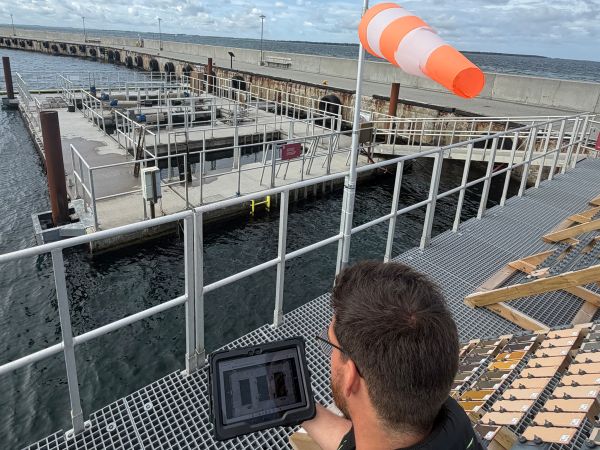
Important workflows also have to work on tablets and phones, including on the raft at the maritime test centre in Hundested. An intuitive interface helps ensure that data are captured where the experiment happens rather than reconstructed later from notes, memory and photographs. The platform also becomes a form of institutional memory: processing procedures, formulations, sample identities and analysis workflows remain available as people move on.
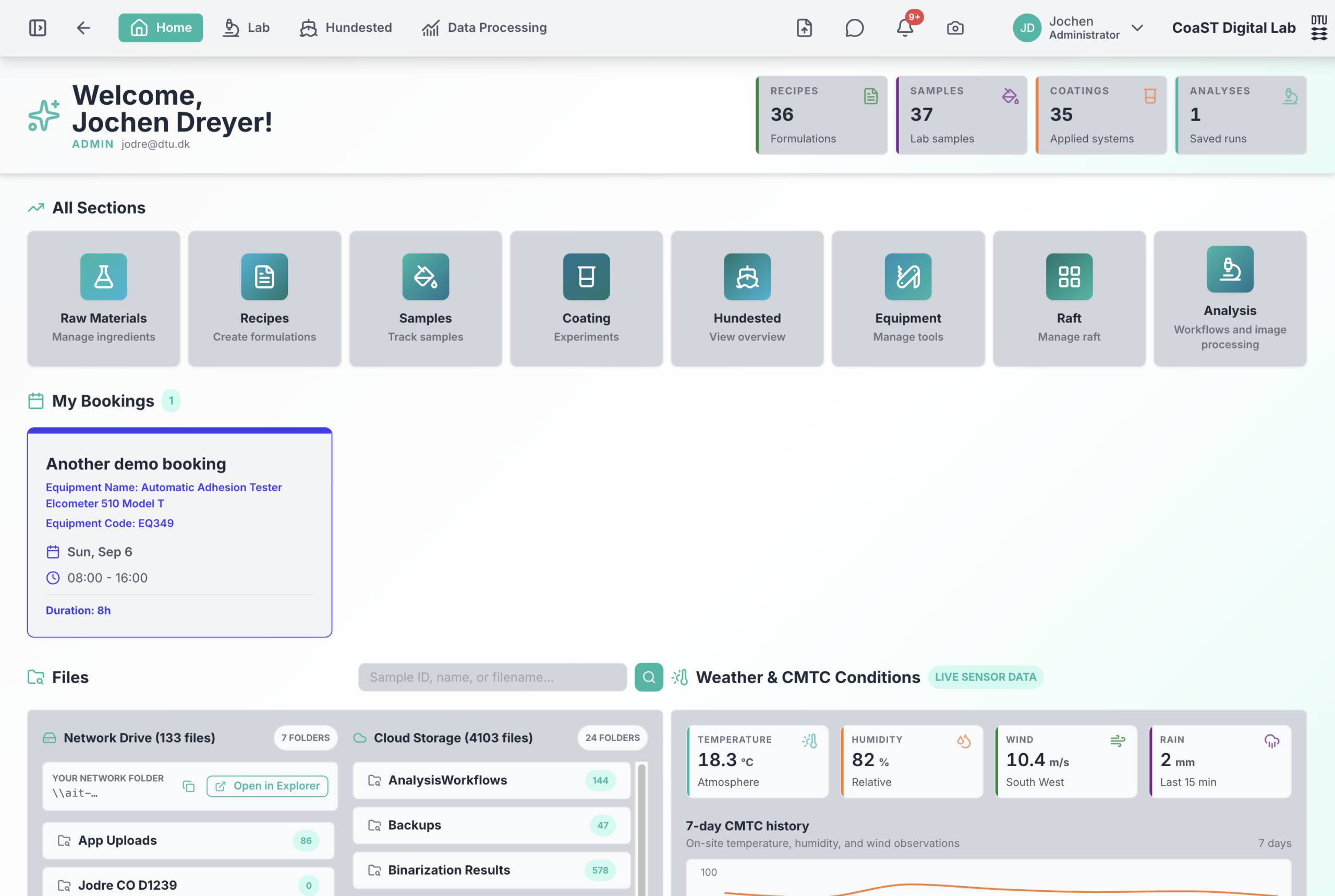 Display of the progamDisplay of the progam<br>Source: Jochen Dreye
From formulation to field exposure
The practical result is an attempt to maintain one connected digital thread through very different stages of coatings research. The CoaST Digital Lab combines raw-material inventory, formulation tools, sample and coating records, equipment booking, measurements, images and files. Formulations can be calculated under constraints such as a target volume solids or lambda value, with binder, pigment and solvent quantities adjusted accordingly, and the processing steps used to prepare the coating stored with the resulting batch.
Coatings can then be linked to substrates and application procedures, including target wet-film thickness. Measurements, images and derived results from automated analysis remain associated with the corresponding specimen, including for multilayer coatings.
The digital thread becomes particularly valuable when the specimen leaves the laboratory. At the CoaST Maritime Test Centre, exposure records can be connected to images acquired over time, automatically derived algae coverage and barnacle counts, and water and weather measurements from the same exposure period. Long-term corrosion experiments are expected to run for more than 10 years, long after individual PhD projects have ended. The aim is to preserve enough context to examine how formulation, processing, application and environmental history contribute to performance and degradation mechanisms.
Building your own system is not the default answer
Undertaking such a development has only been possible for CoaST with the long-term financial support of the Hempel Foundation, and similar investments may simply not be realistic for every university research centre. Developing a production-quality platform is a high-risk, high-gain activity that requires substantial investment in software engineering, security, database design, deployment, testing, user-interface design and long-term maintenance, with no guarantee that the result will be adopted or sustained. CoaST learned this first-hand when earlier digitalisation efforts achieved limited long-term uptake and eventually stopped being maintained. If successful, however, such a platform can become shared research infrastructure, a platform for digitalisation research itself and a foundation for new research projects and funding opportunities, while also providing capabilities that can strengthen the centre’s competitive position.
The next challenge: making coatings data understandable beyond one platform
An in-house platform gives us full control over how the digital environment evolves, allowing it to be tailored closely to our research workflows, integrated with specialised hardware and sensors, and extended as new experimental or digital methods emerge. A separate challenge is interoperability. Even a perfectly structured database can become an isolated data silo if another laboratory, company or software platform represents the same concepts differently.
Formulations, raw materials, processing steps, substrates, coating properties, measurements, ageing procedures, exposure conditions and derived results need sufficiently rich and shared semantic descriptions if data are to become genuinely FAIR and transferable. Different platforms should be able to exchange data without losing scientific meaning.
The same requirement becomes more urgent as AI tools and large language models enter R&D workflows. An LLM can provide an intuitive interface to research information, but fluency is not the same as reliability. Structured provenance, controlled terminology and machine-readable relationships can give such tools better context and make it easier to trace an answer back to the underlying experiment. The next phase of coatings digitalisation will require strong, shared ontologies that define coatings concepts and their relationships in a way that is accepted across academia and industry. Linking data to such ontologies can then provide the semantic foundation for knowledge graphs, making data more interoperable, reusable and accessible to AI-based tools.
Lessons learned
At CoaST, we see the Digital Lab as a foundation rather than a finished product. Around 1,600 specimens are currently registered with their formulation, preparation method and unique sample identity, 13 researchers have each created more than ten specimens, and around ten unique researchers log in on a typical day. This represents substantial uptake, but still only part of the roughly 35 experimental researchers we would ultimately expect to use the platform regularly. Broadening adoption will therefore remain an important priority, alongside further development of automated instrument ingestion, image-analysis workflows and smarter experimental design. The larger lesson from our experience is that building a digital research platform is a major undertaking that requires sustained time, resources and, perhaps most importantly, change management to ensure that the developed tools are actually adopted in daily research practice. Universities therefore need to consider long-term control over methods and data, changing projects, people and funding conditions, and the ability to integrate new research as it emerges. More fundamentally, they need to decide what they want digitalisation to achieve. There is no single model for academic digitalisation: the appropriate approach depends on whether the goal is primarily to manage research data more effectively or to make digital methods themselves part of the research.