News Coatings Technologies
How cool is a cool coating? Digital twins predict thermal performance in buildings
How multiphysics simulation can help formulators assess IR-reflective coatings under realistic conditions and establish the basis for long-term performance prediction. By Yeray López Arauco, based on research by Carson Dorough and Erik Sapper, California Polytechnic State University, San Luis Obispo.

Infrared-reflective coatings are increasingly used to reduce solar heat gain while maintaining the dark or saturated colours demanded in architectural design. Their performance is commonly expressed through solar-reflectance values, but these values alone do not indicate how much cooler a coated wall, interior space or complete building will become.
The relationship between optical performance and building-level thermal response is influenced by multiple interacting factors, including solar intensity, wind, ambient temperature, wall construction, insulation, thermal mass, ventilation and HVAC operation. Preliminary work at California Polytechnic State University, or Cal Poly, is using multiphysics simulation to connect coating-level measurements with these system-level outcomes.
The objective is not simply to model a hot surface. It is to develop the foundation for a validated digital twin capable of predicting how a solar-reflective coating may perform across climates, seasons, orientations and service life.
Reflectance does not equal cooling performance
IR-reflective pigments are designed to reflect a greater proportion of near-infrared radiation while preserving the desired visible colour. This is especially relevant for dark coatings, where conventional pigments can absorb strongly across much of the solar spectrum.
Earlier work by Ray Fernando, Olivia Everitt and Caleb Hall at Cal Poly demonstrated the formulation potential of these materials. In exterior architectural coatings, IR-reflective black pigments achieved substantially higher solar reflectance than conventional carbon black pigments at comparable visible appearance.
However, the study also highlighted an important limitation: coating performance cannot be determined from pigment chemistry alone. Film thickness, substrate colour, filler particle size, gloss, opacity, rheology and application conditions can all affect solar reflectance and, ultimately, thermal behaviour.
The critical question for formulators and building owners is therefore not only which coating reflects more radiation, but whether that optical advantage produces a meaningful reduction in surface temperature, indoor temperature or cooling demand in the final application.
Multiphysics modelling connects the relevant scales
Carson Dorough’s student research project, conducted with Associate Professor Erik Sapper, addresses this challenge through a COMSOL Multiphysics model combining heat-transfer and fluid-flow physics.
The model couples solar absorption at the exterior coating surface with heat conduction through a wall assembly, convection at the internal and external boundaries, and the changing thermal state of the interior space. This approach enables the optical properties of a coating to be translated into a temperature response that is more relevant to real-world use.
The representative wall assembly consists of 12.7 mm gypsum board, 50.8 mm expanded-polystyrene insulation and a second 12.7 mm gypsum board layer. Density, heat capacity and thermal conductivity were defined for each material layer.
Solar loading was calculated using the ASTM G173 reference solar spectrum in combination with experimentally measured coating reflectance. The solar input varies over a 12-hour daytime cycle, while outdoor temperature and wind speed remain fixed within each simulation case. This allows the effect of coating selection to be evaluated without introducing additional weather-related variability.
The model compares an IR-reflective coating with a conventional legacy-pigment coating and uses spatially averaged interior temperature as its primary output. It applies fixed outdoor temperatures and three fixed wind-speed conditions. Its purpose is comparative screening rather than a validated annual building-energy prediction, since HVAC control, open windows and several heat-transfer pathways typical of occupied buildings are not yet included.
A lower solar load can produce a lower indoor temperature
The preliminary simulations compare the IR-reflective coating and the conventional coating under three defined outdoor temperature and wind-speed conditions. Both cases begin with the same internal thermal state and are exposed to the same time-dependent solar loading.
Across the simulated conditions, the IR-reflective coating generally produces a lower spatially averaged interior temperature than the conventional-pigment system. Near the later daytime temperature maximum, the predicted difference is on the order of several degrees Celsius in the preliminary model.
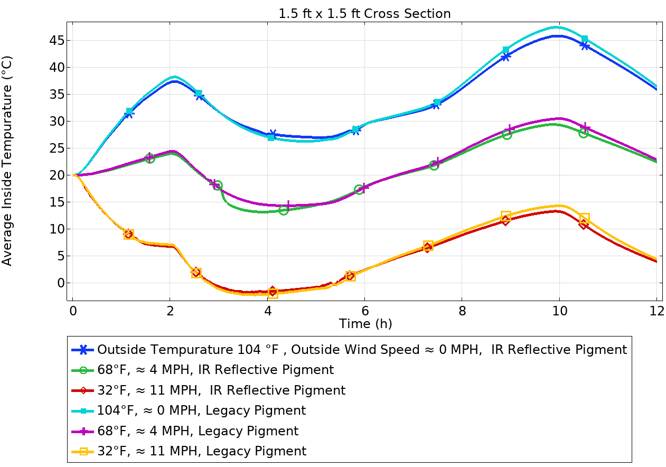
This result is significant because it translates a spectral measurement into a practical thermal outcome. Reflectance data show how much sunlight a coating rejects; the multiphysics model estimates the consequence of that difference for the coated wall and adjacent interior environment.
At the same time, the simulations demonstrate why coating performance must be assessed in context. In a cold environment, reduced solar absorption may also reduce beneficial passive warming. The optimal coating therefore depends on climate, season, orientation, building construction and operating strategy rather than on a single reflectance value.
The temperature differences predicted by the current model should not be interpreted as product-performance claims. The geometry is simplified, external conditions are prescribed and the model has not yet been calibrated against measurements from an instrumented wall or room. Its immediate value lies in comparative screening: determining whether a coating’s measured optical advantage is sufficiently meaningful to justify further formulation work, panel testing and field validation.
Digital twins extend modelling beyond the fresh coating
A finite-element model becomes a digital twin when it is connected to measured material data and continuously improved through validation. For solar-reflective coatings, the first layer of such a twin links spectral reflectance and thermal emittance to the heat balance of the coated substrate.
Subsequent levels of complexity can incorporate local weather files, solar angle, roof or wall orientation, building geometry, ventilation, occupancy and HVAC control. This would enable formulators and building professionals to assess thermal performance under application-specific rather than generic conditions.
A particularly important future capability is the inclusion of aging. Coating reflectance can change during service because of soiling, roughening, chalking, fading, binder degradation or other weathering mechanisms. Laboratory and outdoor-exposure data could be used to update the optical properties within the twin and estimate how the cooling benefit changes over time.
This is a more informative question than whether a freshly prepared panel meets a laboratory requirement. It addresses whether the coating continues to deliver useful thermal performance after years of exposure.
Digital screening can improve formulation decisions
For formulators, a digital twin could change the starting point of product development. Rather than selecting pigments solely on the basis of maximum solar reflectance, laboratories could evaluate which formulation changes produce a meaningful temperature or energy benefit in the intended application.
Sensitivity analysis could compare the influence of pigment package, coating thickness, substrate colour, insulation level, wall construction, geographic location, façade orientation and aged optical properties. It could also reveal diminishing returns. Increasing reflectance may not always produce a proportional reduction in indoor temperature if another heat-transfer path, such as limited insulation, air leakage or internal heat generation, becomes dominant.
This type of analysis can also make experimental programmes more efficient. If the prediction is highly sensitive to thermal emittance, moisture uptake or aged reflectance, these properties can be prioritised for measurement rather than being treated as fixed assumptions within the calculation.
Validation will determine the model’s practical value
The Cal Poly work remains preliminary student research, and empirical validation is the next essential step. An instrumented test wall or small enclosure could compare the two coating systems while recording surface temperature, heat flux, indoor air temperature, solar irradiance, ambient temperature and wind conditions.
These measurements would identify where the model needs refinement and establish uncertainty bounds for later predictions of annual energy use or service-life performance. The intention is not to replace outdoor exposure testing, weathering studies or full building-energy modelling.
Instead, a validated digital twin could connect these activities. It can reduce blind experimental screening, help laboratories focus resources on the most influential variables and make the thermal consequences of formulation decisions visible earlier in development.
Outlook
Solar reflectance is an essential coating property, but it is only the starting point for understanding thermal performance. The actual benefit of an IR-reflective coating depends on the interaction between its optical properties and the building system in which it is used.
Multiphysics simulation provides a route from measured spectral data to temperature and energy outcomes that are more meaningful to formulators, architects and building owners. Once validated against physical experiments and expanded to include weathering and realistic operating conditions, a coating digital twin could become a valuable tool for designing products that remain thermally effective throughout their service life.