News Coatings Technologies

Towards the identification of the volatile organic compounds emitted by the coatings used in a car factory painting line
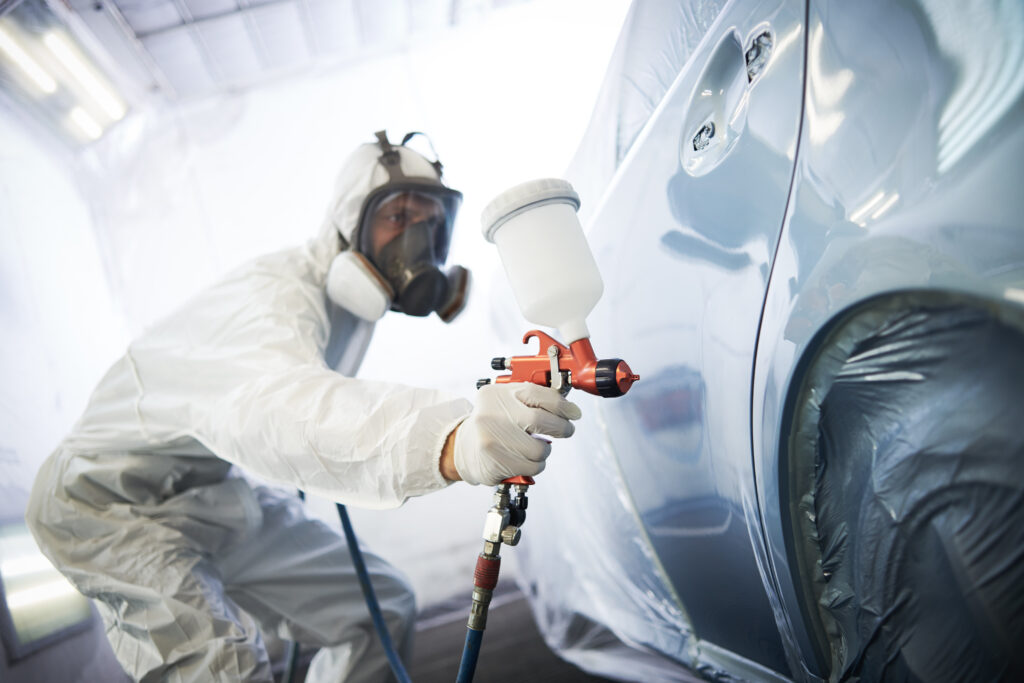
Researchers found that coatings used in a car factory emit 45 volatile organic compounds (VOCs) that pose potential health risks to workers.
Air quality in automotive painting lines is a significant challenge due to numerous volatile compounds impacting indoor air. Source: Kadmy - adobe.stock.com

One of the main reasons for the degradation of working conditions is the lack of air quality. It is known that indoor air contaminants pose a risk to both the human organism and the environment, which constitutes a challenge for employers and major industries. A car factory painting line is an evident example of a work location in which the employers must be especially aware and concerned with the employees’ health. Since the coatings are the main VOCs-emitting source, this work studied the analytes emitted by four primers, 17 basecoats and one varnish used in a car factory of a world-renowned automotive brand, with gas chromatography-ion mobility spectrometry (GC-IMS), as a way of identifying all the coating-borne VOCs that can be emitted to the indoor air.


Event Tip: Fundamentals of Functional Coatings

Dive into the world of functional coatings designed to offer specialized properties such as anti-fouling, anti-ice, easy-to-clean, and drag reduction. This tutorial will cover fundamental principles, materials selection, surface modification techniques, and case studies across different applications. Join us online on 03 Oct 2024 for the EC Short Course “Fundamentals of Functional Coatings” and explore how these coatings are transforming industries worldwide.


The variability of the collected data was assessed, and the repeatability of the results proved the suitability of GC-IMS for this type of study. Among primers, inks and varnish, 45 VOCs were accurately identified using an exclusively developed database of compounds. The presence of the identified analytes in the composition of the coatings represents the potentiality of being emitted to the indoor air of the factory and, consequently, denotes their eventual toxicity for the employees of the painting line. These results represent a step forward in the assessment of the panting line work conditions, so eventual consequences to the employees’ health are theoretically discussed; nonetheless, further studies aim to examine air samples of the factory and evaluate the work conditions and actual consequences to the employees that must be developed.

Journal of Coatings Technology and Research, Volume 21, pages 665–682, (2024)

Advertisement:

Similar posts

News Coatings Technologies

Wood-based phase-change composites regulate indoor temperature

Researchers demonstrate how vacuum impregnation of n-octadecane into delignified wood, combined with strategic surface coatings, produces bio-based phase-change composites for intelligent thermal management....

Allnex announces strategic investment at Rayjong site in Thailand
News Markets & Companies

Allnex: Taking SCAs to the next level

Allnex is expanding its sag control agent (SCA) production capacity at its Rayong site in Thailand, marking the company’s first SCA manufacturing location outside Europe in more than 40 years.

News Coatings Technologies

Nanohybrid HP@ZIF advances fire-retardant coatings for steel

Researchers have developed an organic-inorganic hybrid nano-flame retardant, HP@ZIF, that significantly improves fire resistance and smoke suppression of intumescent coatings for steel structures. The...

News Coatings Technologies

Machine vision detects and grades chipping in automotive coatings

Researchers have developed an automated machine vision system for the objective detection and grading of chipping defects on automotive coatings. The method delivers consistent results, correlates strongly...

News Markets & Companies

Olin and Huntsman clear key antitrust hurdle in planned merger

The planned merger between chemical manufacturers Olin and Huntsman has passed a significant regulatory milestone in the United States. The expiration of the waiting period under the HSR Act clears one...

What are current trends and challenges in aerospace coatings?
News Application Areas

Aerospace coatings: “Every layer, every micron of film build and every application step must be considered carefully”

Combining performance, durability and sustainability in aerospace coatings is no easy task. Aurore Bournazel, Segment Manager at Akzo Nobel, discusses how advances in formulation and application processes...

News Coatings Technologies

Cerium oxide improves biocide release in antifouling paint

Researchers have incorporated cerium oxide nanoparticles as a non-toxic co-biocide into self-polishing antifouling paint. The additive improves antibacterial activity, increases hydrophilicity and enhances...