News News Raw Materials
What is next for Greatham – the ‘jewel in the crown’ of Venator?
LB Group (formally Lomon Billions), a leading manufacturer of titanium dioxide (TiO2) pigments and titanium sponge headquartered in Jiaozuo, China, has made an offer to buy the Venator Greatham plant in the UK. What is next for the site? By Kenneth Beattie, contributing author
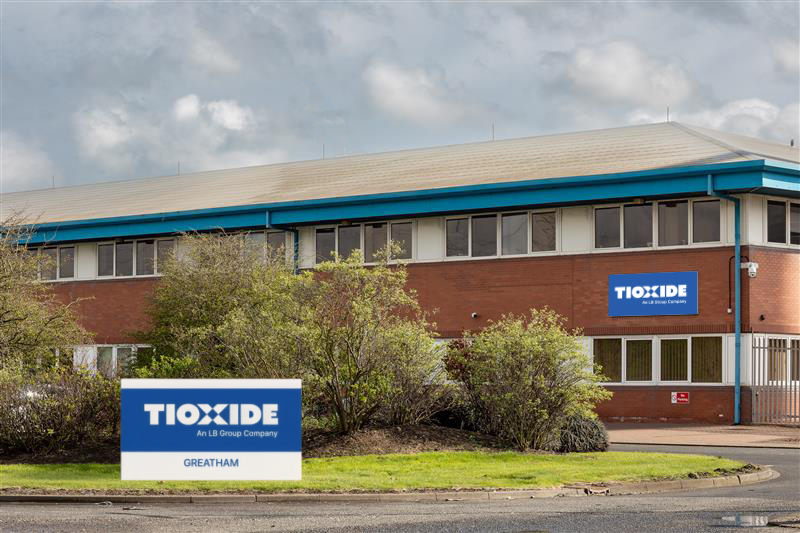
Venator is one of the largest titanium dioxide producers in Europe and North America. Its Greatham plant is the company’s only facility that uses the more efficient and environmentally-friendly chloride process, with an annual production capacity of 150,000 tons [1]. The future of the Venator plant at Greatham has been subject to speculation in 2025: while company directors have remained positive, the market situation in relation to the demand for titanium dioxide has been challenging and demand has fallen from its highest point of 7.25 million tons in 2021 to around 7 million tons or less in 2025.
The Greatham plant has also faced challenges with selling its products in the European market due to the surplus availability of TiO2 which has largely come from China. In the last five years or so China has expanded the number of TiO2 production facilities across provinces irrespective of market demand. Excess TiO2 arriving in the European market from China has dampened demand and following complaints from the industry also led to the European Commission (EC) imposing anti-dumping duties on TiO2 imports from China.
Although surplus TiO2 from China will have undoubtedly played a part in reducing profit margins at Greatham, global economic growth has been slowing from 2.9% in 2023 to a predicted 2.5% in 2025. Production costs at Greatham have also increased in recent years, largely due to rising energy costs, especially natural gas and electricity. The plant specialises in production via the chlorine route which yields a higher purity of TiO2 than alternative production methods but is energy intensive as temperatures higher than 1000°C are required.
These are some of the factors that ultimately led to administrators from Alvarez & Marsal being appointed to Venator Materials, the top non-trading holding company in the Venator Group in September 2025. Julie Reid, Marketing Director, LB Group at Stockton on Tees in the UK, confirmed that “LB Group remains fully committed to completing the APA (Asset Purchase Agreement) transaction” which “could take several months, and there is no guarantee that successful completion will be achieved.”
What are the next steps for Greatham?
“Venator is the world’s sixth largest TiO2 pigment manufacturer, with nearly 400,000 tonnes/y of TiO2 capacity – 150,000 tonnes/y at Greatham” explains Reg Adams, Managing Director of Artikol UK and titanium dioxide expert who compiles the monthly journal “Focus on Pigments”.

Although the plant is currently idle, the aim of LB Group according to its press release of 23 October 2025 is to “restart TiO2 pigment production at Greatham and invest in its capabilities and integrate it into our global production network when conditions allow”. Adams underlines: “Certainly Venator Greatham was renowned for offering good quality pigment products and for employing technical people respected in the industry for their experience and expertise. Those would have been attractive features for any purchaser”.
Although management on both sides (Venator and LB Group) clearly value the technical expertise at Greatham, the workforce has already been scaled back considerably since the liquidators Alvarez and Marsal were called in on 22 October 2025 as an immediate measure to curb financial losses. 273 out of 505 employees were immediately made redundant and 232 employees remain at the plant who, according to Venator UK, have been retained “to support the liquidation process”. The union Unite also sees the Greatham site as ’the jewel in the crown’ of Venator’s operations. “The plant and its workforce produce a world-class product making titanium oxide and performance additives for paint and plastics used in everyday items” [2].
What attracted LB Group to Greatham?
Apart from the technical expertise of the workforce, the technical facilities at the site are also a valuable asset to the new owner of the Greatham plant. It employs patented “Icon” chloride-route technology which is undoubtedly an attractive feature. The history behind the development of the technology at Greatham which spans more than half a century, starting with the first commercial-scale TiO2 plant in March 1972, with an initial capacity of 30,000 tonnes per year.
It was owned by British Titan Products (BTP, a predecessor of Venator) which in 1971 claimed it spent more than USD 2.4 million had been on research and development of chloride-route TiO2 pigment technology. A new unit was installed at Greatham in 1991 employing the “Icon” process involving the use of a direct-current plasma torch for the pressurised oxidation of TiCl4.
A second “Icon” unit was installed in 2002 and a third in 2009, which brought the annual capacity up to 150,000 tonnes. Adams concludes: “Effectively, LB will be acquiring the 150,000 tonnes/y chloride-route TiO2 plant – and exclusive rights to Venator’s “Icon” technology – for USD 560 per tonne/y of TiO2 capacity.” He underlines: “There are a number of niche specialty TiO2 products that Venator was producing – for solar cells, self-cleaning surfaces, food, pharmaceuticals, catalysts, etc. Selling such products is associated with relatively high profit margins, but the volumes are small.” He adds: “For virtually all TiO2 manufacturers, the main end-use sectors to concentrate on are paints and plastics, Those two sectors typically account for around 80% of the total TiO2 sales volume.”
LB Group has been ESG-certified by EcoVadis and aims to reduce its Scope 1&2 carbon emissions by 30% by 2030 and 100% by 2060. It will also reduce its solid waste emissions in the chloride process by 90%. It aims to reduce its energy consumption by 5% by 2030, which may present challenges at Greatham as the TiO2 manufacturing process is extremely energy intensive.
In conclusion, if all goes according to plan, Greatham will resume production of TiO2 in the near future. This is likely to be accompanied by some restructuring at the plant and integration of the workforce and technology into the LB Group global manufacturing network.
References
[1] China’s Titanium Dioxide Giant Makes a Move: LB Group Acquires UK Venator Assets https://www.echemi.com/cms/2642532.html
[2] Unite responds to Teesside-based chemicals firm Venator going into administration: https://www.unitetheunion.org/news-events/news/2025/september/unite-responds-to-teesside-based-chemicals-firm-venator-going-into-administration
Other sources
Tees Business – Venator Materials UK agrees sale of Greatham site:
https://teesbusiness.co.uk/2025/10/16/venator-materials-uk-agrees-sale-of-greatham-site/
PROJECTBLUE – China’s LB Group tightens hold on global TiO2 capacity with UK acquisition – Jessica Roberts:https://projectblue.com/blue/news-analysis/1358/china%E2%80%99s-lb-group-tightens-hold-on-global-tio2-capacity-with-uk-acquisition