News Production & Lab
Bio-based networks with shape memory and recyclability
A Chinese research team has developed a novel bio-based polymer system that is not only fully recyclable but also has an adjustable shape memory. The dithioacetal-based networks can be reused multiple times without sacrificing mechanical properties.
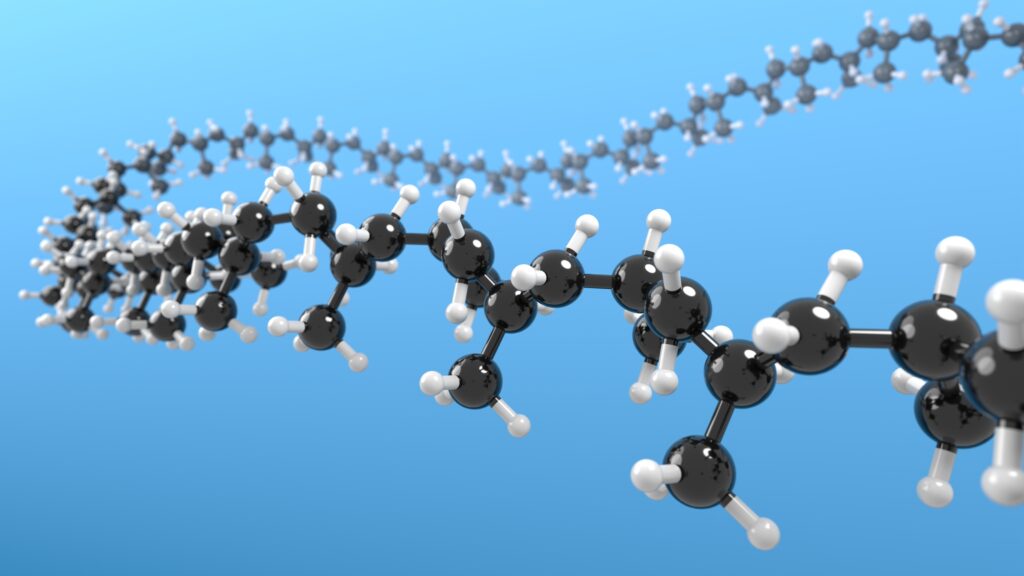
The team led by Yanfeng Zhang from Zhejiang University has developed polydithioacetal-based covalent adaptive networks (PDTA-CANs) from renewable raw materials. The crosslinking is achieved by a solvent-free polyreaction at room temperature between benzaldehydes of plant origin and tetra-thiol monomers. The key to the material concept lies in the reversible dithioacetal bond, whose exchange reaction occurs under mild conditions.
The polymers not only exhibit remarkable recyclability, including mechanical reprocessing, chemical recycling and conversion back into monomers, but also self-healing properties. The mechanical performance is maintained – even after multiple reuses. This makes PDTA materials attractive for long-lasting applications with high sustainability requirements.
Reading tip: Functional Coatings
The EC Tech Report “Functional Coatings” gives you an up-to-date bundle on functional coatings with articles, videos and other handpicked content. In addition to technical articles about the latest technical developments, this all-in-one multi-media pack is rounded off with valuable market insights and important fundamentals about functional coatings formulation.
Shape memory with adjustable activation temperature
Another key feature is the materials’ shape-memory capability: by adjusting the cross-linking density, the activation temperature can be precisely controlled – right up to triggering at body temperature. In a demonstration experiment, a PDTA shrink stent was placed in a blood vessel, where it automatically expanded at 37°C and provided mechanical support.
This demonstrates the potential of these novel materials in the field of biomedical implants and functional coating systems. Their hydrolytic stability, biocompatibility and flexible processing make them promising candidates for future applications in which sustainability and functionality are to be combined.
Source: Polymer Chemistry, Issue 13, 2025, DOI: 10.1039/d4py01915h