News News
Climate change impacts on exterior coatings: challenges and adaptive solutions in Bangladesh
Bangladesh experiences a monsoon climate marked by distinct seasonal variations. Throughout the year, the country maintains high levels of relative humidity, often exceeding 80% during the monsoon period. In recent years, global climate change has had a severe impact on the region, and Bangladesh has been widely recognized as one of the most climate-vulnerable countries. This increasing climate stress is further intensifying existing environmental and socio-economic challenges, with significant implications for the performance, durability, and long-term sustainability of the paint and coatings industry. B Sk Emadul Bari, Head WB Architectural Coating, R&D, Berger Paints Bangladesh Ltd.

Graph 01 demonstrates a steady rise in the highest daily temperatures over the past five years, clearly indicating the growing impact of climate change. In Bangladesh, the average annual temperature has been increasing at approximately 0.16°C to 0.26°C per decade
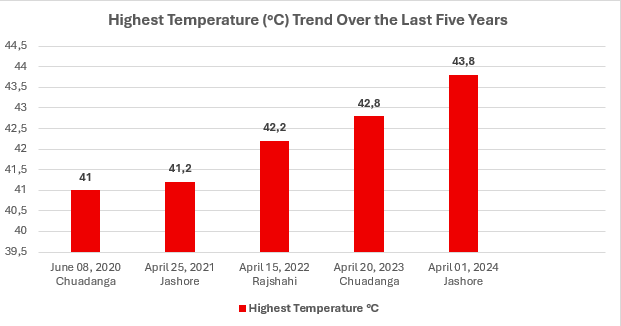
As a result, over the last 20 years, the national average temperature has risen by about 0.3°C to 0.5°C, with the most pronounced increase observed during the summer and monsoon seasons.This warming trend is even more intense in urban areas, driven by rapid urbanization, reduced green spaces, and high population density. In major cities such as Dhaka, studies suggest that average daytime temperatures have risen significantly by 2.7°C to 3°C over the past two decades.
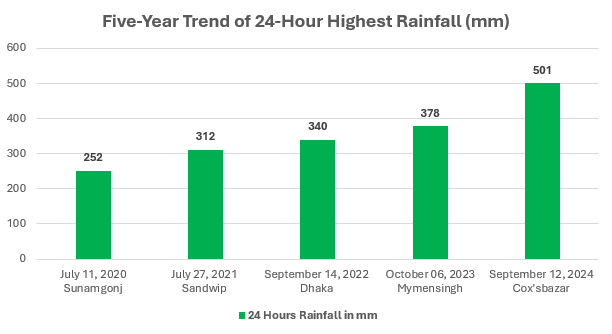
At the same time, graph 02 highlights a gradual increase in the highest single-day rainfall over the past five years. It also points to a notable shift in the traditional monsoon cycle, which is no longer limited to the July–September period. Instead, rainfall is increasingly extending into both the pre- and post-monsoon phases, leading to a longer, more prolonged rainy season. Salinity, another devastating consequence of climate change, is affecting Bangladesh, with approximately 35 million people exposed to saline water, causing significant environmental, physical, social, and economic damage.
These climatic conditions significantly affect not only the environment, agriculture, and daily life but also the performance and durability of paint and coating systems. Excessive heat, temperature fluctuations, prolonged exposure to high humidity, heavy rainfall, and salinity can all adversely impact coating integrity, particularly in exterior coatings, making climate-adapted solutions essential for long-term protection and sustainability.
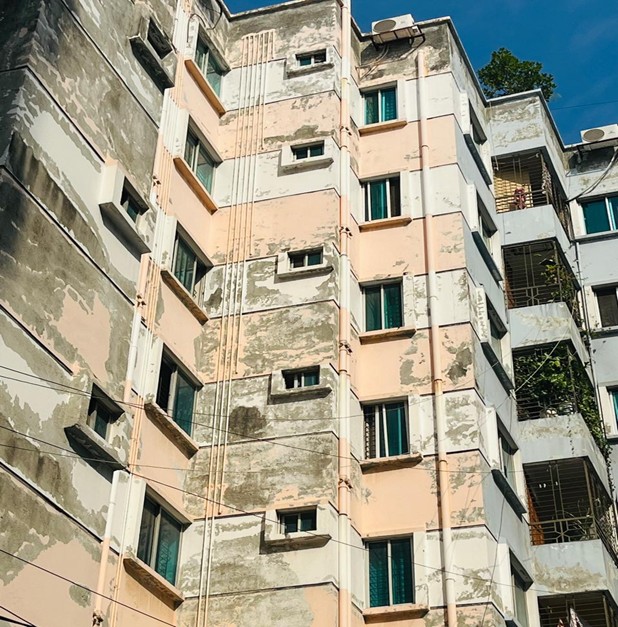
Excessive heat and UV radiation impact on exterior coating: fading
Fading is a common paint defect characterised by the gradual loss of colour intensity from a painted surface over time. In the context of climate change, this phenomenon is becoming increasingly significant due to rising global temperatures and intensified ultraviolet (UV) radiation. Prolonged exposure to excessive heat and stronger sunlight accelerates the chemical degradation of pigments and binders within the paint, resulting in a dull, washed-out appearance. As climate change leads to more extreme weather conditions, including longer, more intense periods of sun exposure, exterior surfaces are particularly vulnerable to rapid fading. Consequently, painted structures lose their original vibrancy and aesthetic appeal at a faster rate than before.
Image 02: Shade Fading

To mitigate the impact of climate-induced fading, it is essential to use high-performance coatings formulated with durable, exterior-grade light-fast pigments, along with heat-resistant and UV-stable properties, for both vertical walls and roofs. These advanced coatings can reduce surface temperatures by approximately 3 to 5°C compared to conventional exterior coatings, thereby enhancing durability, minimizing fading, and preserving the aesthetic appearance over time.Excessive heat induces repeated expansion and contraction of concrete substrates, leading to the development of hairline cracks in exterior coatings. To address this issue, coatings formulated with elastomeric binders are more effective, as they provide enhanced flexibility and crack-bridging properties, thereby improving durability under thermal stress.
Excessive rainfall and moisture: blistering
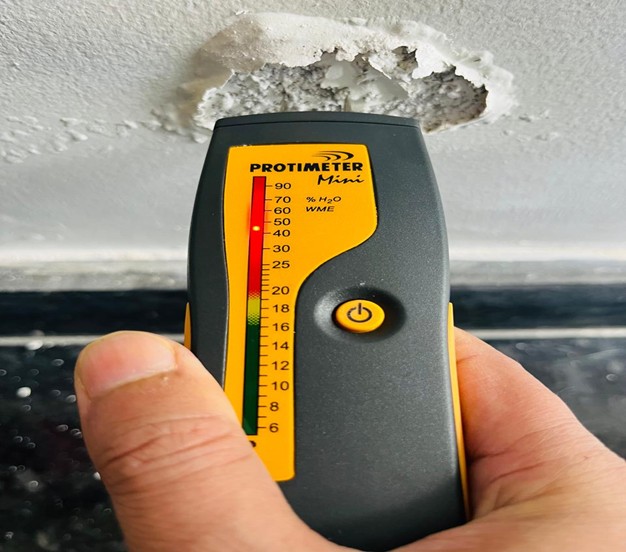
For optimal paint performance, the moisture content of the surface should remain below 15%. However, as illustrated in the image above, the measured moisture level exceeds 40%, which is significantly higher than the recommended limit. This condition is becoming increasingly common due to excessive rainfall associated with climate change, where surfaces remain wet for prolonged periods and absorb high levels of moisture. In such humid conditions, trapped moisture beneath the paint film generates pressure, resulting in the formation of bubbles, commonly known as blistering. These elevated moisture levels severely compromise coating adhesion, leading to surface defects and ultimately causing paint failure.
To address this issue effectively, it is essential to apply either high-performance waterproofing systems or breathable membrane coatings. The choice should be guided by the substrate condition and moisture dynamics, ensuring prevention of water ingress while allowing trapped vapor to escape. This approach minimizes internal pressure buildup and significantly reduces the risk of blistering and coating failure.
Excessive rainfall: Algal growth
During paint formulation, dry film preservatives are incorporated at dosages determined based on expected service conditions, including typical monsoon duration, drying time, and environmental exposure factors. However, under intensified rainfall patterns associated with climate change, the applied paint film may remain in a wet or intermittently moist state for prolonged periods. This extended moisture retention can lead to leaching, dilution, or reduced bioavailability of the preservative system, thereby impairing its long-term efficacy. As a result, the coating becomes increasingly vulnerable to microbiological colonization, particularly algal growth, on the exposed surface.
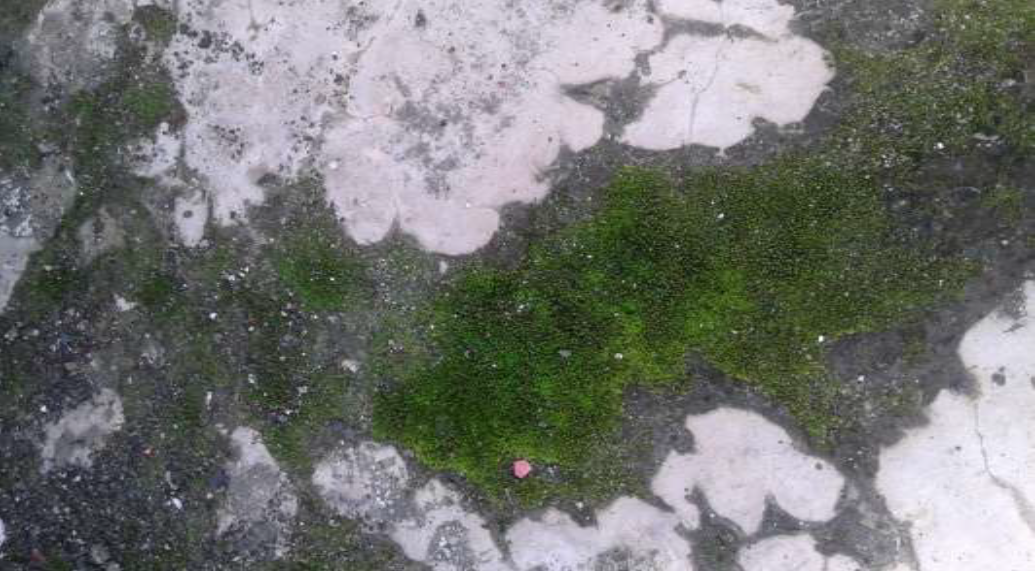
To mitigate algal growth on painted surfaces under conditions of prolonged moisture exposure, it is necessary to optimize the preservative system. This can be achieved by increasing the dosage of dry film preservatives or incorporating highly effective biocidal actives such as diuron-based systems with strong algicidal and fungicidal performance. The use of high-efficacy preservation technologies ensures sustained protection of the coating film, even under extended wet conditions, by improving resistance against microbial colonization, including algae and fungi.
Excessive salinity: efflorescence
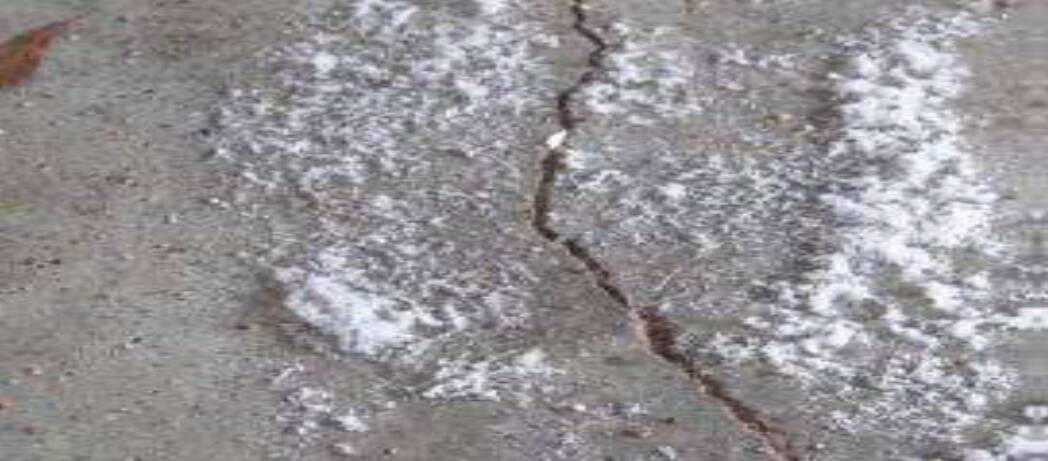
Salt efflorescence is a phenomenon in which fine, white crystalline salts accumulate on the surface of cementitious substrates adjacent to moisture-saturated zones. In Bangladesh, this issue is particularly prevalent in coastal regions where salinity levels are elevated, a condition further exacerbated by climate change–induced seawater intrusion and increased environmental salinity. Construction materials sourced from these areas, such as bricks and sand, inherently contain high levels of soluble salts. When these materials are used in masonry, the salts migrate to the painted surface through capillary action in the presence of moisture, resulting in visible efflorescence. The most commonly encountered salts in such salt-laden walls include sodium sulfate, sodium carbonate, sodium bicarbonate, potassium salts, and calcium sulfate.
This issue can be effectively mitigated through the use of waterproofing coatings that limit water ingress into the substrate. The growing demand for such protective paints is driven by climate change–induced factors, including increased moisture exposure, prolonged saturation, and elevated salinity levels, particularly in coastal environments. Additionally, the application of specialized salt-sealing primers (salt sealers) provides an effective solution by blocking the migration of soluble salts to the surface, thereby minimizing efflorescence and enhancing the durability of the coating system.