News Raw Materials
A new generation of sustainable polyols for high-performing coatings
With growing sustainability demands and stricter regulations, the coatings industry is turning to low-VOC systems from renewable sources. This study explores advanced CNSL-based polyols and diols – derived via optimised processing and cardanol hydrogenation – for use in solvent-free PU and water-borne PUD coatings. Performance testing demonstrated improved colour stability, mechanical strength, hydrophobicity and chemical resistance. By Hong Xu and Pietro Campaner, Cardolite.
Polyurethanes (PUs) are widely used in the coatings industry due to their outstanding durability, toughness, chemical resistance, abrasion resistance, and weatherability. Two-component (2K) PU coatings are typically formed through the reaction between polyols and polyisocyanates. Consequently, the structures and properties of polyols play a critical role in determining the physical, mechanical, and chemical performance of the final PU coating systems.
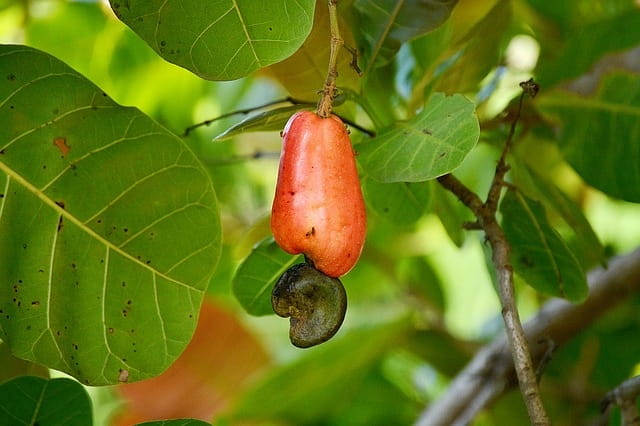
Modern PU coating formulations must also address growing demands for low-VOC, environmentally friendly, and sustainable solutions while maintaining desired high performance. Cashew nut shell liquid (CNSL), a renewable material obtained from the inedible cashew nut shells, is a by-product of the cashew processing industry and offers a promising sustainable alternative without interfering with the food chain.
Cardanol, the major component of CNSL, accounts for over 98% bio-content and serves as a versatile building block for various bio-based derivatives, including polyols and diols. Its unique chemical structure contributes to numerous advantages in CNSL-based polyols and diols, such as high bio-content, non-toxicity, low carbon footprint, and superior coating performance, including excellent hydrophobicity, improved chemical resistance, and enhanced adhesion. These features make CNSL-based polyols and diols attractive raw materials for developing low-VOC, high-performance, sustainable PU coating systems.
Traditionally, CNSL-based polyols have exhibited Gardner colour values ranging from 15 to 18 due to the natural dark colour of CNSL. However, the recent advancements in CNSL processing technology have enabled the development of new-generation CNSL-based polyols and diols with much lighter Gardner colour values below 5. As a result, the colour stability of the light-colour CNSL-based PU coating systems has significantly improved. Hydrogenating cardanol has also led to the creation of ultra-light CNSL-based polyols with water-white colours that are comparable to or even surpass those of some commercial petroleum-based polyols.
This article presents a two-part study: in the first part, we evaluate the coating performance of three generations of CNSL-based polyols in solvent-free (SF) and solvent-borne (SB) PU protective coating systems. There is a particular focus on the benefits conferred by the CNSL structure and the enhanced colour stability provided by the novel ultra-light CNSL-based polyol. In the second part, we assess two water-borne polyurethane dispersions (PUDs) synthesised using a light-colour CNSL-based diol and compare them to a benchmark PUD prepared from a conventional petroleum-based diol.
CNSL-based polyols in PU protective coatings
Table 1 summarises the key properties of three generations of CNSL-based polyols – GEN#1, GEN#2, and GEN#3 – each with over 60% bio-based content. We evaluated these polyols alongside two commercial benchmarks: an acrylic-type polyol (COM-A) and a commercial branched polyester/polyether polyol (COM-B). The CNSL-based polyols generally exhibit viscosities of around 2000 cps, with GEN#2 showing a higher viscosity of approximately 4000 cps, and GEN#1 features higher functionality and a lower hydroxyl value. The progression in colour from GEN#1 (Gardner 18) to GEN#3 (APHA 20) illustrates the significant advances in CNSL processing technology. For crosslinking in PU coating formulations, we used two types of polyisocyanates: a mixture of diphenylmethane-4,4′-diisocyanate (MDI) with its isomers and high-functionality homologues, referred to as PMDI; and a hexamethylene diisocyanate-based aliphatic polyisocyanate, referred to as HDI.
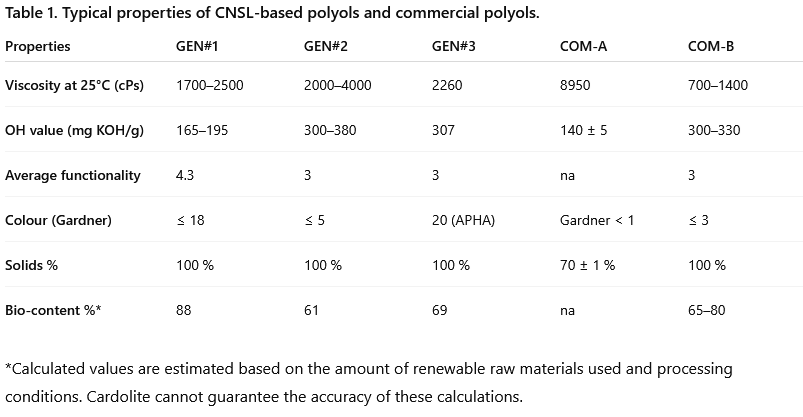
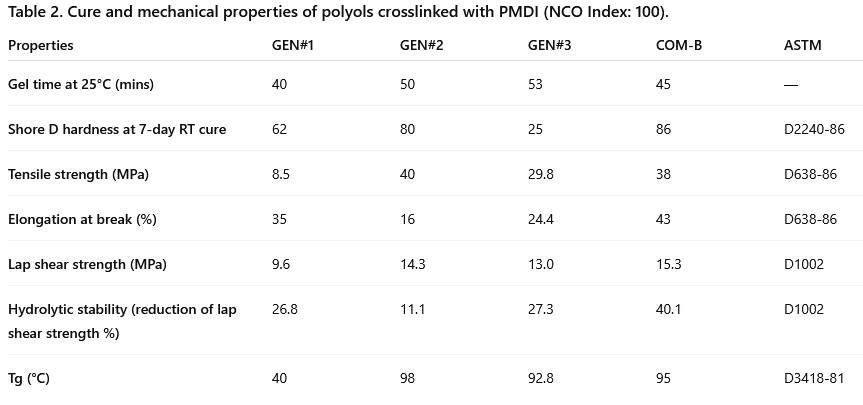
Table 2 presents the basic cure performance and mechanical properties of the three CNSL-based polyols when crosslinked with MDI at an NCO index of 100, without the use of any solvent or catalyst. A high-strength commercial polyol, COM-B, is included as a benchmark. The gel times of all CNSL-based systems were comparable to COM-B, indicating similar reactivity. As CNSL technology advanced, the GEN#2 system showed discernible improvements in ShoreD hardness, tensile strength, lap shear strength, and glass transition temperature (Tg) over GEN#1, achieving performance levels similar to the high-strength COM-B system. GEN#3, based on hydrogenated cardanol, exhibited balanced tensile strength and elongation, high lap shear strength, and Tg, although it was somewhat softer than the other systems.We assessed hydrolytic stability by measuring the percentage reduction in lap shear strength of the same PU system before and after 7-day immersion in 80 °C deionised (DI) water. A lower reduction in percentage indicates better water resistance. GEN#2 showed the lowest reduction, while GEN#1 and GEN#3 exhibited similar values, all significantly better than COM-B. The test results of hydrolytic stability suggest that the hydrophobic nature of cardanol presented in CNSL-based polyols contributes to enhanced water resistance.
Inherent benefits of cardanol derivatives
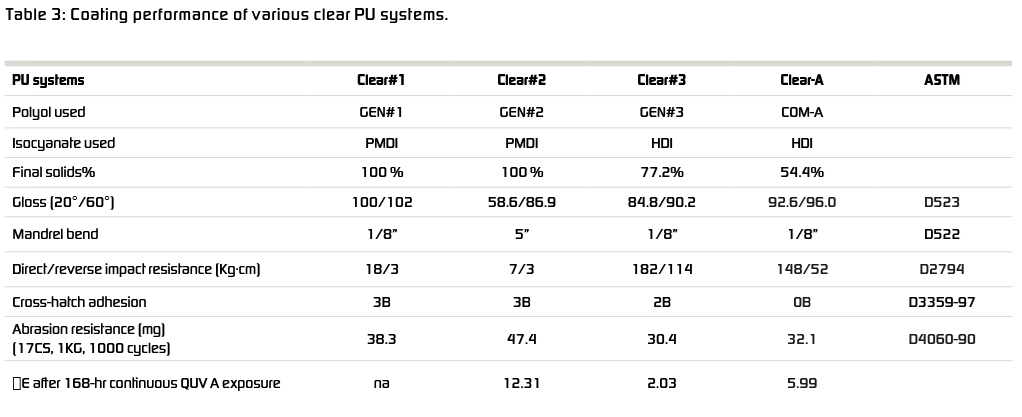
Coating performance was further evaluated using both clear and pigmented PU systems formulated with CNSL-based polyols, alongside an acrylic-type commercial polyol (COM-A) for comparison. Table 3 presents formulation details and basic performance data for the clear PU coatings.
Clear#1 and Clear#2 PU systems were based on GEN#1 and GEN#2 polyols, respectively, both combined with PMDI, requiring no solvent or catalyst. In contrast, the Clear#3 and Clear-A PU systems, based on GEN#3 and COM-A respectively, were formulated with HDI and required some solvent and a small amount of catalyst for compatibility. The Clear#3 formulation achieved a higher final solids content compared to Clear-A, which is attributed to GEN#3 being solvent-free, while COM-A contains 30% solvent in its supplied form. All clear PU systems exhibited high gloss, except for Clear#2, which showed medium gloss at 20°, indicating that it may be suitable for matte finishes. However, Clear#2 was less flexible, likely due to its higher strength and Tg. The Clear#3 system demonstrated the best flexibility, highlighting the benefits of cardanol hydrogenation. All CNSL-based PU systems showed good abrasion resistance comparable to Clear-A, and uniquely, all exhibited measurable adhesion on cold-rolled steel (CRS), a typically challenging substrate, whereas Clear-A showed no adhesion. These results reinforce the inherent benefits of cardanol derivatives, including good compatibility, strong adhesion, and excellent abrasion resistance.
Enhanced UV stability and adhesion
Traditional cardanol grades yield dark-colour polyols, leading to the brown appearance of GEN#1. Technological improvements have enabled the production of GEN#2 with a Gardner colour below 5, although with a slight yellow tint. Hydrogenation of cardanol in GEN#3 achieved a water-white colour (APHA of 20), outperforming even COM-A in colour clarity. Moreover, GEN#3 demonstrated superior UV resistance after QUV-A exposure compared to COM-A: the ΔE values after 168 hours of continuous QUV-A exposure for Clear#3 and Clear-A were 2.03 and 5.99, respectively. The low ΔE values of Clear#3 confirm the dual achievement of improved colour and enhanced UV stability through hydrogenating cardanol.
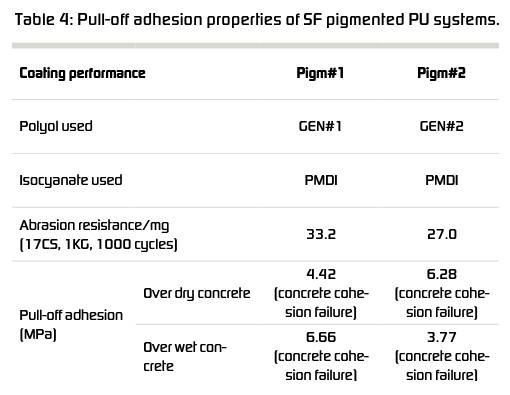
We evaluated the coating performance, including abrasion resistance and pull-off adhesion, for SF pigmented systems of Pigm#1 and Pigm#2 (Table 4). Pigm#2 exhibited better abrasion resistance than Pigm#1, attributed to its enhanced mechanical properties. Both systems showed excellent adhesion to dry and wet concrete substrates, and the cohesion failure of concrete indicated that the CNSL-based polyols maintained superb adhesion even under high-moisture conditions.
Compatibility with HDI remains an area for improvement
Salt spray testing further demonstrated the long-term corrosion resistance of Pigm#1 and Pigm#2 systems on metal substrates, without the use of corrosion inhibitors. Pigm#2 exhibited minimal blistering after 1500 hrs, suggesting that CNSL-derived hydrophobicity contributes to good barrier performance and water resistance. In contrast, the anti-corrosion performance of Pigm#3 and Pigm-A (GEN#3- and COM-A-based pigmented PU systems) was inferior, with blistering evident after 500 hours of salt spray exposure. Pigm#3 still outperformed Pigm-A, with reduced creep and blistering. Two factors may explain the weaker corrosion resistance of Pigm#3 and Pigm-A: (1) a dry film thickness (DFT) of less than 80 µm, compared to 125 µm in Pigm#1 and Pigm#2; and (2) challenges in achieving good compatibility with HDI. Although GEN#3 showed improved compatibility with HDI relative to COM-A due to requiring less solvent, the low glosses observed in Pigm#3 and Pigm-A suggest that compatibility remains an area for improvement. Further development is underway to enhance GEN#3’s compatibility with HDI to improve gloss and corrosion resistance for broader application potential in sustainable PU coatings.
CNSL-based diols used in PUDs for wood coatings
Polyurethane dispersions (PUDs) have gained increasing attention in the coatings industry due to their numerous advantages, including low VOC content, ease of application, rapid cure, excellent wear resistance, high flexibility, and high resistance to water and chemicals. In this study, we used a light-coloured CNSL-based diol to synthesise two PUD systems, PUD-A and PUD-B, using different isocyanates. A third dispersion, PUD-C, based on a polycarbonate diol, was prepared for comparison.
PUD-A and PUD-B were synthesised using the light-coloured CNSL-based diol in combination with HMDI and IPDI, respectively, while PUD-C employed a polycarbonate diol with IPDI. All three PUDs used dimethylolpropionic acid (DMPA) to introduce pendant carboxylic groups for water dispersibility, followed by chain extension with ethylenediamine (EDA). The resulting PUDs exhibited good storage stability and were easily applied via drawdown or brush application over various substrates. They also cured effectively even at low temperatures and high humidity (e.g. 10 °C and 92% RH).
We have summarised the coating performance after a 7-day RT cure in Table 5. All three PUD systems achieved a pencil hardness of 6B, with excellent flexibility and good adhesion on CRS. Notably, PUD-A and PUD-B exhibited abrasion resistance comparable to the benchmark PUD-C.
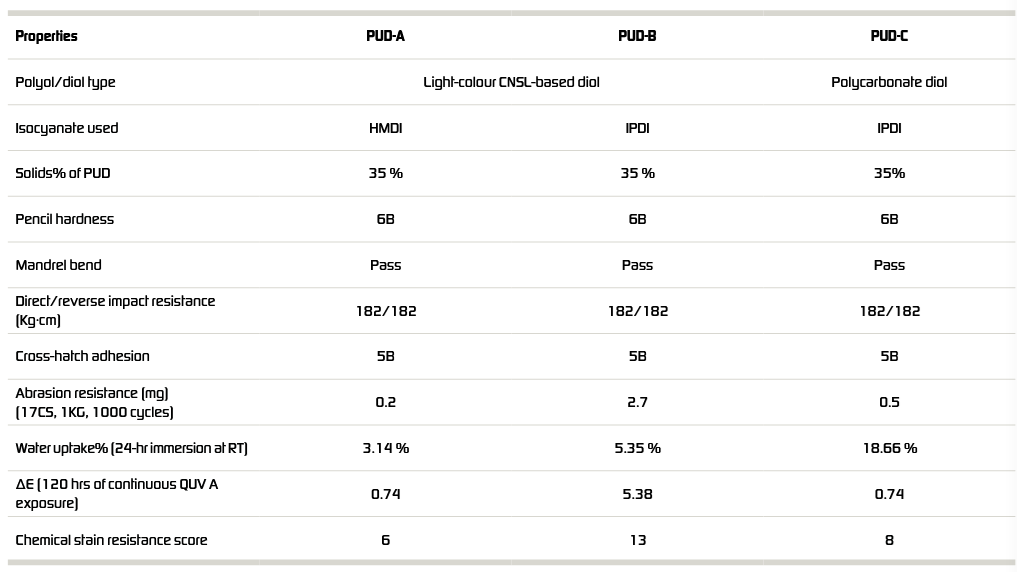
Water uptake % was evaluated by measuring the weight gain of free film (cast in silicone mould and cured at RT for 14 days) after 24-hour immersion in deionised water. PUD-A and PUD-B showed significantly lower water uptake % compared to PUD-C, highlighting the superior hydrophobicity of CNSL-based systems, attributed to the cardanol structure.
Colour stability was assessed via QUV-A accelerated ageing. The ΔE values after 120 hours of continuous QUV-A exposure for both PUD-A and PUD-C were 0.74, indicating that PUD-A maintained colour stability on par with the petroleum-based benchmark (PUD-C), confirming the effectiveness of the light colour CNSL-based diol in UV resistance.
Chemical stain resistance was tested on wood substrates coated with PUDs. We applied ten different chemicals – DI water, coffee, ketchup, olive oil, mustard, red wine, detergent, bleach, 50% ethanol, and 10% NH4OH solution – to the cured film surfaces for specified durations. After exposure, we cleaned the surface with water and rated the condition of each exposed area on a scale from 0 to 5, where a lower value indicates better film integrity (e.g. 0 indicates no change while higher numbers represent increased damage). The chemical stain resistance score was calculated as the sum of the individual ratings across all ten chemicals. The scores for PUD-A, PUD-B and PUD-C were 6, 13 and 8, respectively, indicating that PUD-A achieved the best performance. The test results suggest that CNSL-based PUDs, through optimised formulation, can achieve chemical resistance equal to or better than a polycarbonate-based PUD system.
Merging sustainability with high performance
Ongoing innovation in CNSL technology has enabled the development of advanced CNSL-based polyols that combine good sustainability and high performance. These CNSL-based polyols impart valuable performance benefits to protective PU coating systems, including enhanced hydrophobicity, improved flexibility, and superior adhesion. Moreover, the development of light colour alternatives broadens the scope of formulation possibilities.
Experimental results demonstrate that CNSL-based polyols enhance coating performance by accelerating cure speed, increasing abrasion resistance, and providing excellent flexibility and adhesion to metal and concrete substrates. Good UV resistance is evident in the light colour versions based on hydrogenation technology. All CNSL-based PU systems showed superior hydrolytic stability compared to petroleum-based counterparts, underscoring the moisture barrier properties derived from the cardanol structure.
Furthermore, the comparative study of PUDs revealed that CNSL-based PUDs offer excellent film formation even at low temperatures, strong mechanical performance, and improved chemical stain resistance. Importantly, their significantly lower water uptake compared to petroleum-based systems confirms the enhanced water resistance and barrier property derived from CNSL.